Whisky's Silent Symphony: Mastering Aromatic Layers
Go beyond the first impression and discover the intricate olfactory journey that defines a great whisky.
The Physiology of Scent: Why the Nose Leads the Palate
When we sit down with a dram, our natural instinct is to take a sip. We want to feel the texture, the heat, and the immediate flavor on our tongue. But did you know that your tongue is actually a bit of a blunt instrument? In the world of whisky nosing techniques, we recognize a scientific truth that often surprises newcomers: between 80% and 90% of what we perceive as "flavor" is actually derived from our sense of smell. Our taste buds are limited to basic sensations—sweet, sour, salty, bitter, and umami—but our nose can distinguish thousands of individual chemical compounds. This happens through two pathways: ortho-nasal olfaction (breathing in through the nose) and retro-nasal olfaction (aromas traveling from the back of the mouth to the nasal cavity as we swallow).
The magic happens in the olfactory bulb, a structure located just behind the bridge of your nose. Unlike our other senses, which are routed through the brain’s "relay station" (the thalamus), the olfactory bulb has a direct, VIP connection to the limbic system. This is the ancient part of the brain responsible for emotion and long-term memory. This is exactly why a single whiff of a heavily peated Islay malt can instantly transport you to a rainy beach bonfire from ten years ago, or why a sherried Speyside might trigger a vivid memory of your grandmother’s Christmas cake. It’s not just a "smell"; it’s a biological time machine.
At a molecular level, this works via the "lock and key" theory. Whisky is a complex chemical soup, and specific molecules—called ligands—float into your nostrils and bind to specific receptors. Each receptor is a lock, and each molecule is a key. When the right key finds the right lock, it sends a spark to your brain, which translates that signal into "vanilla," "smoke," or "green apple." Some of these compounds are incredibly potent. For instance, the phenols derived from peat smoke have a remarkably low "threshold of detection." We can sense them at parts-per-billion, while other fruity notes might require a much higher concentration for us to notice them.
However, the nose is a delicate tool. If you spend too long sniffing the same glass, you’ll encounter "olfactory fatigue." Your receptors become saturated, and they simply stop sending signals to the brain to save energy. This is why professional tasters often take breaks or reset their senses by smelling something neutral. While some suggest coffee beans, the best method is often smelling your own clean skin (the back of your hand) or simply stepping into fresh air for a minute. By managing your olfactory journey whisky experience with these breaks, you keep your "locks and keys" ready for the next layer of the symphony.

The Chemistry of the Bouquet: Understanding Volatile Organic Compounds
To truly master the art of the whisky tasting guide, we have to look under the hood at the chemistry. The aromatic profile of a spirit is largely defined by "congeners." These are the chemical substances produced during fermentation and distillation that provide the primary character of the liquid. While ethanol provides the "kick," the congeners provide the soul. Among the most famous of these are Esters. If you’ve ever detected a distinct note of banana, pear drops, or red apple in your glass, you’re likely smelling Isoamyl acetate or Ethyl hexanoate. These fruity, floral notes are the light, dancing top-notes of the spirit's bouquet.
On the darker side of the spectrum, we find Phenols and Guaiacols. These are the heavy hitters responsible for the medicinal, smoky, and "band-aid" notes found in whiskies from regions like Islay. These molecules are significantly heavier and less volatile than esters, meaning they tend to linger longer in the glass and on the palate. When you swirl a peated whisky, you’re helping these heavier molecules overcome their inertia so they can reach your nose. Without that agitation, the "smoke" might remain hidden beneath the lighter spirit notes.
Then there are the Aldehydes and Ketones. Depending on how the distiller manages the "cut" (the point where they stop collecting spirit and start discarding the "tails"), these can contribute everything from sharp, green-grass notes to rich, buttery, and nutty characteristics. It is a delicate chemical dance. For example, Diacetyl is the ketone responsible for that wonderful buttery popcorn smell found in some Chardonnays and, occasionally, in very well-crafted malt whiskies. Understanding these whisky esters and phenols is like learning the individual instruments in an orchestra; once you know what they sound like alone, you can appreciate the full concerto much more deeply.
Temperature plays a vital role in how these compounds behave. Chemistry dictates that higher temperatures increase "volatility"—the ease with which a liquid turns into a gas. If you hold your glass in your palms and warm it slightly, you are physically energizing the "heavy" molecules, like the oils and phenols, forcing them to rise. Conversely, if you chill a spirit or add ice, you are effectively "locking" the aromatic spectrum. This is why high-end whiskies are rarely served cold; you’d be muting the very chemistry you paid so much to enjoy.
The Glassware Variable: Engineering the Perfect Nosing Environment
If you're still drinking your single malt out of a wide-rimmed "rocks" tumbler, you’re missing out on half the experience. Whisky glassware science tells us that the shape of the vessel is just as important as the liquid itself. This is why the Glencairn glass has become the gold standard. Its design is intentional: the wide bowl allows for a large surface area for the whisky to breathe, while the tapered mouth acts as a chimney, concentrating the aromas toward a single point. This concentration is vital for detecting those subtle "whisky maturation aromas" that would otherwise dissipate into the room in a standard tumbler.
Contrast the Glencairn with the traditional Copita—the stemmed glass often used by Sherry blenders. The Copita offers even more precision, allowing the taster to keep their warm hand away from the liquid if they want to maintain a specific temperature. The tumbler, by contrast, is the enemy of the nose. Its wide opening allows the ethanol—the lightest and most volatile component—to rush out and overwhelm your senses, while the more delicate esters are lost to the wind. In a Glencairn or a tulip-shaped glass, the ethanol is directed up the sides, leaving a "sweet spot" in the center for the actual flavor molecules.
We should also talk about the "Neck-Pour" phenomenon. Have you ever opened a brand-new bottle, poured a dram, and felt it was a bit... underwhelming? Perhaps it smelled "tight" or overly alcoholic. This is because the whisky in the neck of the bottle has had limited contact with oxygen. Once the bottle is opened and a few drams are removed, the "headspace" increases, allowing for a mini-oxidation process. This aeration helps the aromatic layers "unfurl." Modern innovations like the Norlan glass attempt to mimic this by using internal fins to increase surface area and aeration during the swirl, without losing the concentrated "chimney" effect of a traditional nosing glass.
Finally, never underestimate the importance of glass cleanliness. Even a tiny residue of dish soap or the "cabinet smell" (that dusty, woody scent of a cupboard) can completely distort the subtle top-notes of an expensive malt. Always rinse your glass with a little bit of the whisky you're about to drink—a process known as "priming" the glass—to ensure that every molecule hitting your olfactory bulb is exactly what the distiller intended.
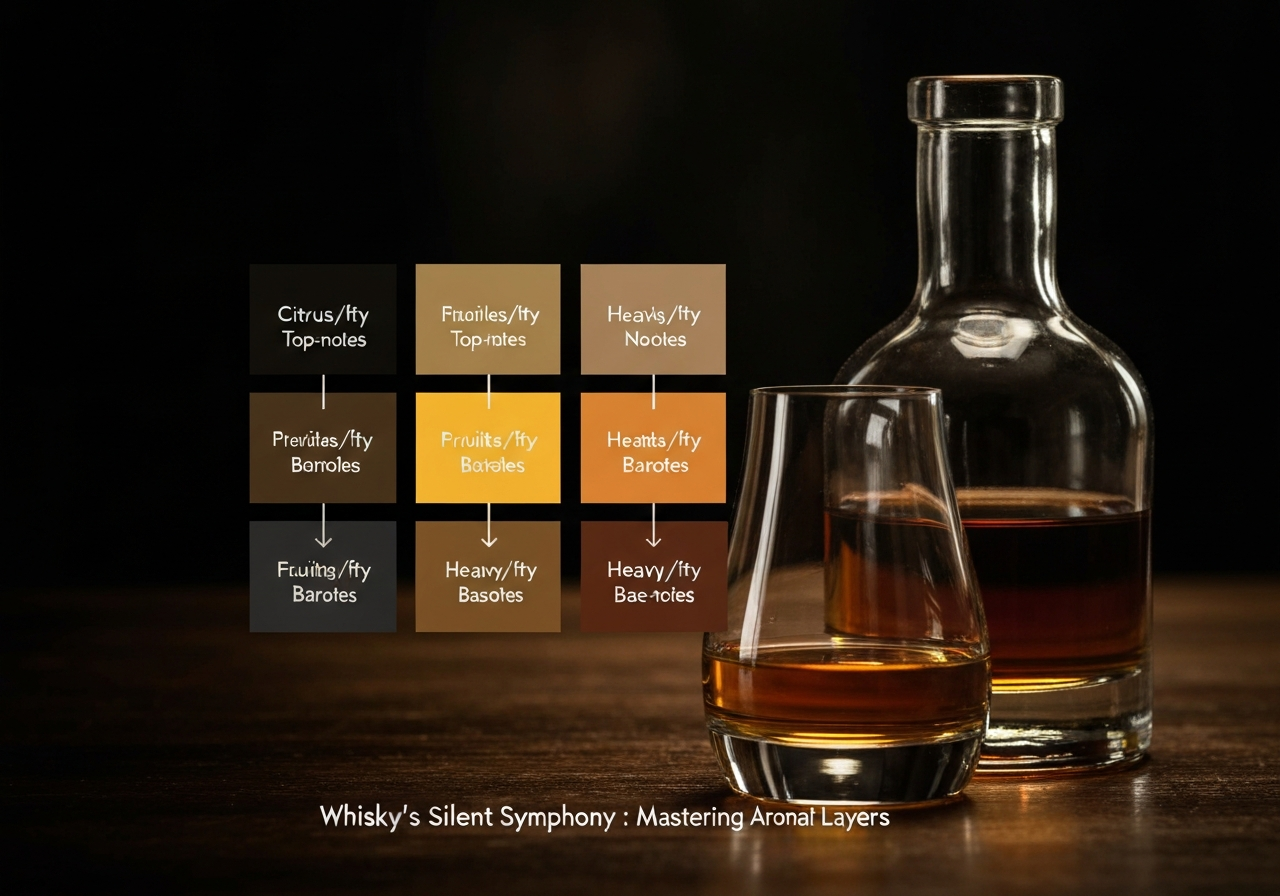
Navigating the First Wave: Piercing the Alcohol Veil
One of the biggest hurdles for those learning how to smell whisky is the "Alcohol Prickle." This isn't actually a smell; it’s a physical sensation of pain. High-proof ethanol triggers the trigeminal nerve, the same nerve that reacts when you eat a spicy chili pepper or sniff a bottle of ammonia. If you stick your nose straight into a glass of 46% ABV whisky and take a deep breath, your brain will scream "danger," and your olfactory receptors will shut down to protect themselves. To get to the "silent symphony" underneath, you have to move past this veil.
The best way to do this is the "Drive-By" technique. Instead of diving in, hold the glass at chest level and slowly bring it toward your face, or move the glass in a horizontal arc under your nose. This allows the heavier, more pleasant aromatic molecules to reach you while the sharpest ethanol vapors disperse. As you get closer, try the "Mouth-Ajar" secret. By keeping your mouth slightly open while you nose the whisky, you create a secondary airflow. This allows the alcohol vapors to pass through your nasal cavity and out your mouth (or vice versa), preventing the ethanol from "pooling" and overwhelming your sensors. It feels a bit silly at first, but it is the most effective way to detect the "whisky aromatic layers" hidden behind the proof.
I always recommend the "Three-Nose Rule." Your first sniff is almost always a shock to the system—it’s just the brain acknowledging the presence of high-strength alcohol. Don't judge the whisky yet! The second sniff is where the broad categories appear: you’ll notice "Fruit," "Smoke," or "Grain." It’s only by the third sniff that your nose has acclimatized enough to find the fine details—the toasted marshmallow, the damp moss, or the zest of a blood orange. This patience is the hallmark of a true enthusiast.
This is especially critical when dealing with "Cask Strength" whiskies, which can hover between 55% and 65% ABV. At these levels, the risk of "temporary anosmia" (a temporary loss of smell) is very real. Treating a high-proof dram with the same physical proximity as a glass of wine is a mistake. You have to flirt with a cask strength whisky from a distance before you can get intimate with its aromatic complexity.
Primary vs. Secondary Aromas: From Grain to Fermentation
To understand what’s in your glass, it helps to know where those smells come from. We categorize these into layers. Primary Aromas are the scents of the raw ingredients. If you smell the biscuit-like maltiness of barley, the "chewiness" of oats, or the spicy, peppery rye notes common in American whiskies, you are smelling the earth itself. These notes are often more prominent in younger whiskies where the wood hasn't yet had time to overshadow the base spirit. If you’ve ever walked through a distillery’s malting floor, that sweet, earthy, dusty grain smell is the "Primary" foundation of every single malt.
Secondary Aromas are the products of the distillery’s process—specifically fermentation and distillation. This is where the "distillery character" is born. During fermentation, yeast eats sugar and poops out alcohol and CO2, but it also creates those esters we talked about earlier. The length of fermentation matters: a short fermentation (around 48 hours) tends to produce more cereal and nutty notes, while a long fermentation (75+ hours) allows the yeast to produce those complex, floral, and fruity esters. This is why some whiskies smell like a flower garden while others smell like a bakery.
The shape of the stills also plays a massive role via "Copper Contact." Copper is a miraculous metal; it acts as a catalyst, stripping away unwanted sulfur compounds (which smell like rotten eggs or burnt rubber) from the vapor. Tall stills, like those at Glenmorangie, provide a huge amount of copper surface area and "reflux" (where vapor condenses and falls back down to be re-distilled). This creates a light, elegant, and floral spirit. Conversely, small, squat stills—like those at Mortlach—result in less copper contact, allowing some of those heavier, "meaty," or sulfurous compounds to survive into the final spirit. This creates a "heavy" distillate that can stand up to long years in the cask.
Distillers also make a "cut" between the foreshots (the early, solvent-like part of the run) and the feints (the late, oily, and pungent part). Where they make this cut determines the spirit's profile. A "narrow" cut produces a very clean, citrusy, and floral whisky. A "wide" cut brings in more of those oily, leathery, and tobacco-like notes. Historically, when stills were direct-fired by coal, the "hot spots" on the bottom of the still would slightly singe the wash, creating a toasted, nutty character. Modern steam-heated stills are more consistent, but some argue they’ve lost that bit of "maillard reaction" magic that defined 20th-century Scotch.
Maturation and Tertiary Layers: The Wood’s Silent Contribution
Once the "new make" spirit goes into the barrel, the wood takes over. It is widely accepted in the industry that up to 70% of a whisky’s final aromatic profile is derived from the time spent in the cask. These are the Tertiary Aromas. This process is three-fold: Additive, Subtractive, and Interactive. The Additive process is the most famous. American Oak (Quercus alba) is rich in vanillins and oak lactones, which provide those classic notes of vanilla, coconut, caramel, and honey. If your whisky smells like a Crème Brûlée, you can thank the American oak barrel.
The Subtractive process is equally important but less discussed. Before a barrel is filled, the inside is charred. This creates a layer of charcoal that acts as a giant filter. As the spirit moves in and out of the wood's pores due to seasonal temperature changes, the charcoal pulls out the last remaining harsh sulfur compounds. This "cleans" the spirit over time, turning a rough new-make into a smooth, refined whisky. This is why a 25-year-old whisky often feels "gentler" on the nose than a 5-year-old; the wood has literally scrubbed the spirit clean.
Then we have the influence of the cask's previous contents, most notably Sherry. European Oak (Quercus robur) casks that once held Oloroso or Pedro Ximénez Sherry contribute a totally different set of tertiary layers. Here, we find the deep, oxidative notes: raisins, dried figs, dates, dark chocolate, and "Christmas spices" like clove, cinnamon, and nutmeg. These are heavy, rich aromas that can completely transform a light, floral distillate into a dark, brooding masterpiece. When we talk about whisky maturation aromas, we are often talking about this beautiful marriage between the wood species and the wine that lived there before.
Finally, there is the Interactive phase. This only happens with significant time—usually 15 to 20 years or more. As the spirit breathes through the wood, it interacts with the oxygen from the warehouse (the "Angels' Share" is the liquid that evaporates, but oxygen also enters). This creates "rancio." Rancio is a complex, earthy aroma that’s hard to describe but easy to recognize once you’ve found it—think of old leather, forest floor, mushrooms, or even a hint of tropical fruit that has turned slightly funky. It is the hallmark of a truly aged spirit, a sign that the wood and the whisky have finally become one.
The Alchemy of Dilution: How Water Unlocks the Symphony
One of the most controversial topics in any whisky tasting guide is whether or not to add water. Let me settle it: science says you should at least try it. There is a specific molecule called Guaiacol that is particularly prevalent in peated whiskies. Research has shown that at higher alcohol concentrations, guaiacol molecules tend to be "trapped" by ethanol clusters. When you add a drop of water, it breaks the surface tension and disrupts these clusters. This effectively pushes the guaiacol (and other flavorful esters) to the surface of the liquid, making them more volatile and significantly easier to smell.
Adding water is like opening a window in a stuffy room. A whisky that feels "closed" or "dormant"—where the aromas are packed tightly together—will suddenly "bloom" with the addition of hydration. This is especially true for older whiskies that have spent decades developing complex oils. Those oils are hydrophobic (they hate water), so when a drop of water hits the spirit, the oils are repelled toward the surface, releasing a burst of fragrance that was previously suppressed by the ethanol.
However, there is a danger of "over-dilution." If you add too much water, you drown the spirit. You lose the "texture" or "mouthfeel," and the delicate balance between the fruity esters and the woody tannins is broken, often leaving you with a glass that smells mostly of bitter wood and wet cardboard. The trick is to be a scientist about it. Always nose the spirit neat first. Then, using a pipette or a small spoon, add water literally drop-by-drop. Watch the "viscimetric swirls" (the oily streaks) form in the glass. After each drop, nose it again. You will witness a real-time evolution where new notes—perhaps a hidden citrus peel or a soft violet note—suddenly emerge from the shadows.
This process of dilution is a key part of the olfactory journey whisky experience. It turns a static drink into a dynamic experiment. Some whiskies, especially those bottled at 40% or 43%, may not need any water at all as they’ve already been "opened up" at the bottling plant. But for anything over 46%, and certainly for Cask Strength expressions, a drop of water is the key that unlocks the door to the silent symphony.
The Ghost in the Glass: The Power of the Empty Vessel
Here is a professional tip that separates the amateurs from the aficionados: the "Dry Glass" test. After you’ve finished your dram, do not immediately rush to the sink to wash your glass. Let it sit on the table for ten, twenty, or even sixty minutes. As the last remnants of alcohol and water evaporate, they leave behind the least volatile, "heaviest" molecules—the resins, the sugars, and the long-chain esters that were too heavy to be detected easily while the glass was full.
This "ghost in the glass" is often where the most beautiful and surprising aromas reside. In a high-quality Speyside malt, the empty glass might smell intensely of honey, beeswax, and old library books. In a heavily peated Islay, the initial "aggressive" smoke might settle into a soft, sweet pipe tobacco or a scent of cold charcoal and sea salt. These long-chain esters are the backbone of the whisky, and they reveal the true quality of the cask. If the empty glass smells sour, metallic, or overly bitter, it’s a sign that the wood was perhaps exhausted or of lower quality.
I often find that the empty glass tells the most honest story of a whisky's age. A young whisky’s ghost is often faint and simple—just a bit of sugar and grain. But a 30-year-old whisky will leave a residue that smells rich and perfumed for hours. I’ve even known some enthusiasts who leave their empty glasses out overnight just to see what the "morning-after" scent is like. It’s a diagnostic tool that helps you judge the "texture" of the base spirit; a spirit with a lot of "oiliness" will leave a much more persistent and fragrant ghost than a spirit that was distilled to be light and thin.
Next time you’re enjoying a session, compare the empty glass of a Sherry-matured whisky against a Bourbon-matured one. The Sherry ghost will be spicy and heavy with dark fruit, while the Bourbon ghost will be all vanilla and toasted coconut. It’s a final, silent movement in the symphony that most people miss because they’re too quick to clean up. In the world of whisky nosing techniques, the finish isn't over until the glass is dry.
Building Your Sensory Library: Training Your Nose for Complexity
If you've ever read a review and thought, "How on earth did they find 'sun-dried tomatoes' or 'old leather' in this?", don't worry. Nosing is a skill that can be trained. The best way to start is with the "Aroma Wheel." Start with broad categories: Is it Woody? Fruity? Herbal? Smoky? Once you’ve picked a category, drill down. If it’s Fruity, is it "Fresh Fruit" (like apples) or "Dried Fruit" (like raisins)? If it's "Fresh Fruit," is it "Citrus" (lemon/orange) or "Stone Fruit" (peach/apricot)? This "top-down" approach prevents you from feeling overwhelmed.
Your homework? Get into the kitchen. Most of our aromatic memories are dormant because we don't pay attention to them. Spend a week smelling everything: the spice rack, the zest of a lime, a freshly opened bag of coffee, the smell of rain on hot pavement (petrichor), or even an old leather belt. By consciously naming these smells, you are building a "mental catalog." When you later encounter a specific aldehyde in a Highland malt, your brain will have a "file" to match it to, and you'll triumphantly exclaim, "That’s apricot!"
Horizontal tastings are another fantastic training tool. Try three different whiskies that have the same "finish"—for example, three different malts all aged in Oloroso Sherry casks. This allows you to isolate the "Sherry" notes and see how they interact with different distillery characters. You’ll start to see how the "base" of the spirit changes the way the wood presents itself. And please, keep a nosing journal. Documenting your initial impressions—even if they seem silly at the time—helps solidify your aromatic memory and allows you to track how your palate evolves over the years. You'll be amazed at how much more you can "hear" in the symphony after just a few months of practice.
Finally, remember the "Subjective Truth." There are no wrong answers in nosing. My "red apple" might be your "pear" because your childhood memories of those fruits are different from mine. Perhaps you grew up in a house with a cedar chest, so "woody" notes always smell like cedar to you, whereas I might smell "pine." Both are correct. Your personal history is the lens through which you experience the whisky. The goal of mastering whisky aromatic layers isn't to get the same answer as the master blender; it's to understand the story the liquid is telling you. So, pour a dram, take your time, and listen to the silent symphony in your glass. Slàinte!