Whiskey's 'Wood Whispers': Decoding Cask Influence Simply
Understand how different barrels shape your whiskey's flavor, from vanilla to spice.
The Invisible Ingredient: Why Wood Matters More Than You Think
Have you ever poured yourself a glass of your favorite single malt or small-batch bourbon and wondered where that deep amber glow comes from? Or why a spirit that starts its life as a clear, fiery liquid ends up tasting like a decadent slice of vanilla sponge cake or a rich, leathery library? To the uninitiated, whiskey is a product of grain, water, and yeast. But to those of us who spend our time decoding the nuances in every drop, we know there is a silent partner in the distillery: oak barrel aging.
Industry experts generally agree on a staggering statistic: between 60% and 80% of a whiskey’s final flavor profile, and 100% of its natural color, come from the time it spends inside a cask. When the "new make" spirit first drips from the copper pot stills, it is crystal clear and surprisingly harsh. Depending on the mash bill, it might taste of sweet cereal, raw bread dough, or perhaps a hint of metallic pear. In many parts of the world, this raw state is what we’d call "moonshine" or "white dog." It’s energetic, but it lacks the soul and sophistication that only time and timber can provide.
Think of the barrel not just as a storage container, but as a living, breathing organ. As the seasons change, the barrel acts like a lung. When it’s warm, the spirit expands and pushes deep into the pores of the wood; when it cools, the liquid retreats, pulling out flavored compounds from the oak. Simultaneously, the barrel is "exhaling" harsh impurities. The wood pores allow for a slow, controlled oxidation, where unwanted chemical compounds like sulfur are filtered out and transformed. This is what we call the whiskey maturation process—a delicate dance of additive and subtractive maturation. The wood adds the flavors we love, like caramel and spice, while subtracting the "bite" and rough edges of the raw alcohol.
Interestingly, we didn't always know this was the secret to great whiskey. Historically, wooden barrels were simply the most convenient way to transport liquid. In the 18th century, distillers noticed that whiskey left in wood for long sea voyages or forgotten in the back of a warehouse tasted significantly better than the fresh stuff. What began as a logistical necessity evolved into the most critical part of the craft. Today, we don't just use barrels for transport; we use them to weave a complex whiskey flavor profile that keeps us coming back for more.
The Anatomy of Oak: Nature’s Perfect Container
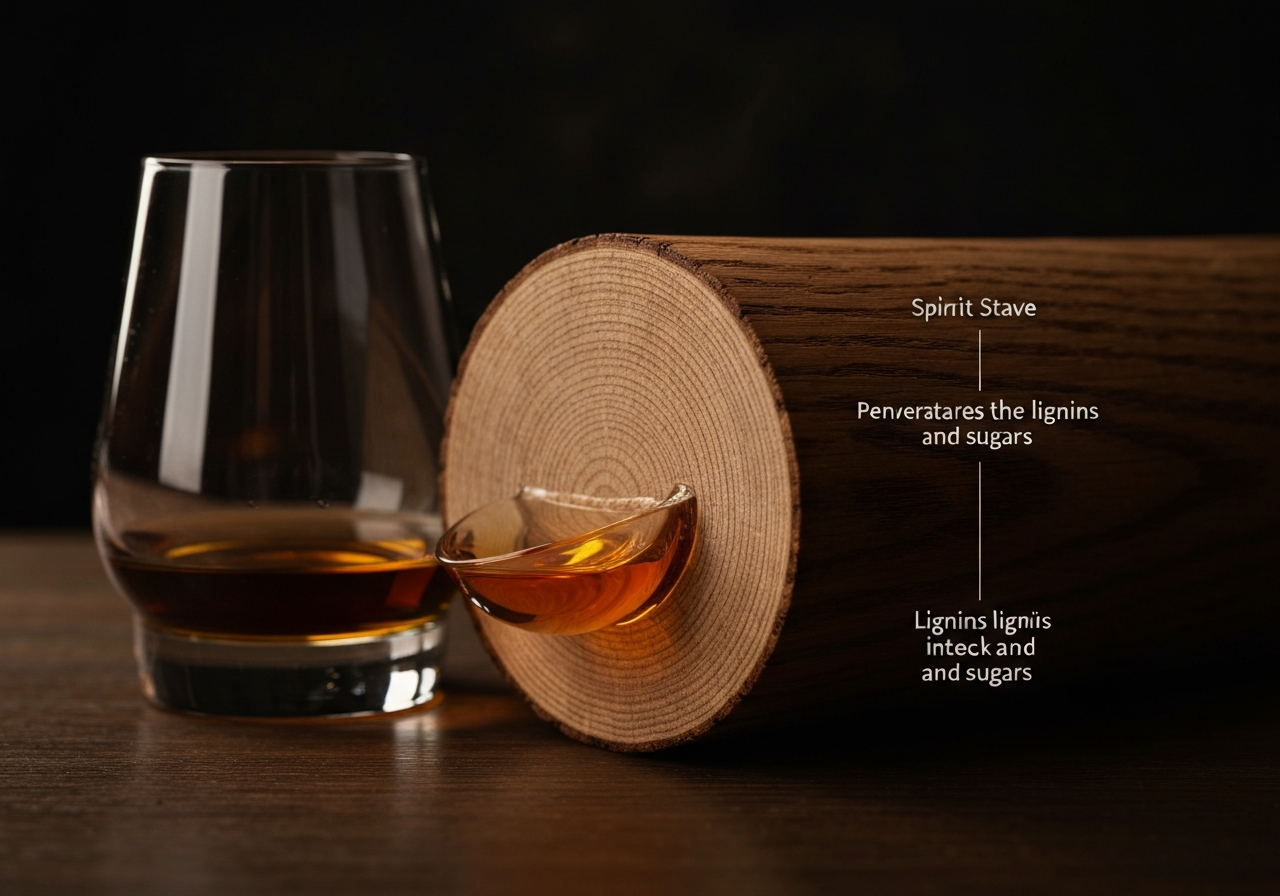
While distillers have experimented with everything from chestnut to acacia, oak remains the undisputed king of the warehouse. Why? Because oak is a biological marvel. It possesses a unique cellular structure that makes it "liquid tight" yet "gas porous." It can hold 50 gallons of liquid for decades without leaking a drop, yet it still allows the spirit to "breathe" and interact with the outside air. Inside those staves, a complex chemistry set is waiting to be activated by the alcohol.
The first key player is Lignin. These are complex organic polymers that act as the "glue" holding the wood fibers together. As the high-proof spirit breaks down these lignins over the years, they transform into vanillin—the very same chemical compound found in expensive vanilla beans. This is why almost every whiskey you taste will have at least a whisper of vanilla on the nose or palate. It’s not an additive; it’s the wood literally "bleeding" its sweetness into the spirit.
Then we have Hemicellulose. This is a collection of wood sugars that are highly sensitive to heat. When a cooper (a barrel-maker) heats the inside of a barrel, these sugars caramelize. This process is responsible for the deep butterscotch, toffee, and maple syrup notes we find in well-aged expressions. Without these caramelized sugars, whiskey would lack that rich, "chewy" sweetness that balances out the heat of the alcohol. This also provides the deep mahogany and amber hues that we associate with premium spirits.
We can't talk about oak without mentioning Tannins. Much like in a dry red wine or a cup of black tea that has steeped for a bit too long, tannins provide the "structure" and "mouthfeel" of the whiskey. They add a pleasant dryness to the finish that prevents the whiskey from being cloying. Finally, oak is rich in Oak Lactones. These are especially prevalent in American white oak and are responsible for the creamy, coconut-like aromas that are the hallmark of many classic bourbons. When you understand these components, you realize that the barrel isn't just a box; it's a spice rack.
American vs. European Oak: A Tale of Two Continents
If you’re just starting your beginner guide to whiskey, one of the most important distinctions you’ll learn is the difference between American and European oak. Just as terroir affects grapes in wine, the species of oak tree and where it grows radically changes the whiskey cask influence. It’s essentially a battle between two species: Quercus Alba and Quercus Robur.
Quercus Alba, or American White Oak, is the workhorse of the industry. Growing mostly in the Eastern United States, it is a fast-growing, dense-grained wood. Because it’s so dense, it can be "sawn" into staves, which breaks more of the wood’s cells and allows the spirit to access those lovely vanillins and coconut lactones much faster. American oak is often described as providing a "vertical" flavor profile—it’s bright, sweet, and hits the high notes of honey, vanilla, and tropical fruit. It’s the reason bourbon is so approachable and bold.
On the other side of the Atlantic, we have Quercus Robur, or European Oak. This wood is much more porous and grows more slowly, resulting in a grain that is rich in tannins and spicy compounds. Unlike American oak, it must be "riven" (split along the grain) to stay liquid-tight, which is a more labor-intensive and expensive process. European oak provides a "horizontal" flavor profile—it’s deep, heavy, and provides a dark base of flavors like cloves, dried ginger, cinnamon, and walnuts. This is the wood often used for aging Sherry, which we will discuss later.
A fun fact for your next tasting: Scottish distillers often prefer "ex-bourbon" American barrels not just because they are more affordable (thanks to American laws requiring new barrels for bourbon), but because they provide a lighter, more delicate sweetness that doesn't overwhelm the subtle peat smoke or floral notes of the Scottish spirit. The choice between American and European oak is like a painter choosing between a bright watercolor palette and a moody oil paint set. Both are beautiful, but they tell very different stories.
The Alchemy of Fire: Toasting and Charring Explained
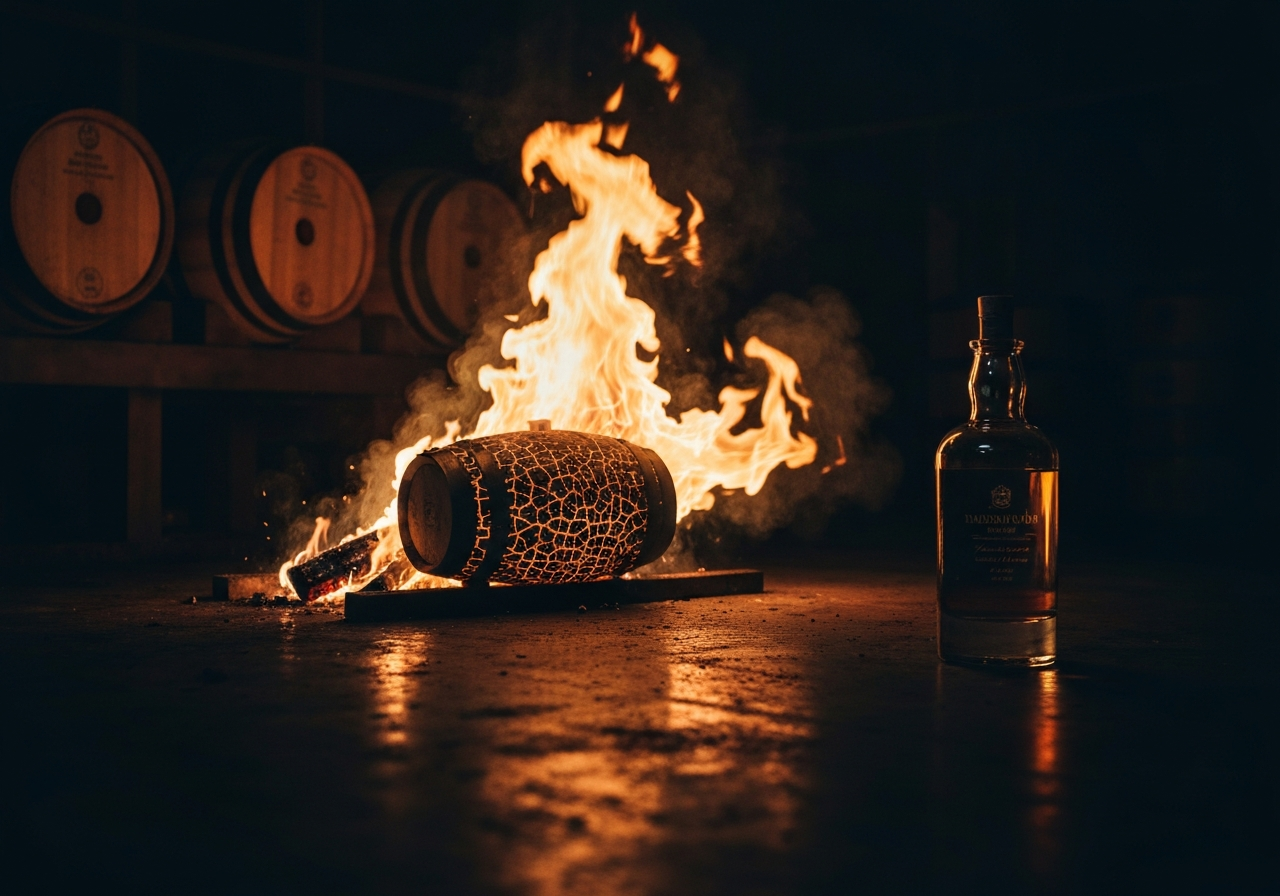
Raw oak, while flavorful, is a bit like a raw potato—it needs a little heat to make it truly delicious. In the world of coopering, fire is the catalyst that "primes" the wood for maturation. There are two distinct ways distillers use fire: toasting and charring. While they might sound similar, they serve very different purposes in the oak barrel aging process.
Toasting is a gentle process. The barrel is placed over a controlled flame for an extended period, heating the wood through without actually setting it on fire. This gently caramelizes the wood sugars (hemicellulose) we mentioned earlier. If you’ve ever smelled a bakery at 5:00 AM, you know the aroma of toasting. It brings out notes of toasted marshmallow, baked bread, and light honey. Toasting is common in wine barrels and is increasingly used in "toasted finish" whiskeys that want to emphasize sweetness without the smokiness of a heavy char.
Charring, on the other hand, is much more dramatic. The inside of the barrel is literally set ablaze for 15 to 60 seconds. This creates a layer of black carbon (charcoal) on the inside of the staves. Distillers often refer to the "Alligator Char" (or Level 4 Char), where the wood is burned so intensely that the surface cracks and ripples like a reptile’s hide. This isn't just for show; the char layer acts like a natural carbon filter—much like the one in your Brita water pitcher. As the spirit moves through this charcoal layer, it strips away metallic notes and sulfurous compounds, resulting in a much smoother final product.
Without this alchemy of fire, whiskey would remain pale, astringent, and unpleasantly "woody." The heat breaks down the physical structure of the oak, making it easier for the spirit to penetrate the "red layer" just behind the char where the concentrated flavors live. It’s the difference between eating a raw coffee bean and enjoying a perfectly roasted espresso. Fire unlocks the magic hidden within the cellulose.
The First Use vs. Refill: Why 'Virgin' Wood Packs a Punch
In the world of whiskey, "virginity" is a matter of intense legal and flavor-based debate. If you’re drinking Bourbon, you are drinking a spirit that, by U.S. law, must be aged in "new charred oak containers." This means the whiskey is the very first liquid to touch that wood. Because the barrel is "fresh," it is at its most potent. It’s packed with vanillin, sugars, and tannins that are ready to jump into the spirit. This is why Bourbon matures relatively quickly and has such a bold, "in-your-face" sweetness.
But what happens after that first use? Once the Bourbon is emptied, the barrel still has plenty of life left, but its most aggressive flavors have been "exhausted." These are sold to Scottish, Irish, or Japanese distillers as "first-fill ex-bourbon" casks. In these secondary uses, the wood is more mellow. A first-fill cask will still give you plenty of vanilla and caramel, but a "second-fill" or "refill" cask is even more subtle. These refill casks are highly prized because they allow the distillery's unique spirit character—the flavors from the yeast and the shape of the stills—to shine through rather than being buried under a mountain of oak.
"Think of a tea bag. The first time you dunk it in hot water (the Bourbon stage), you get a dark, intense, tannic brew. The second time you use that same bag (the Scotch stage), the tea is lighter, more nuanced, and reveals subtle floral notes you couldn't taste before."
Size also matters here. Most people are familiar with the standard American Standard Barrel (ASB) which holds about 200 liters. However, Scotch distillers often break these down and rebuild them into "Hogsheads," which hold about 250 liters. The larger the barrel, the lower the surface-area-to-liquid ratio. Smaller barrels (like "quarter casks") speed up maturation because more of the liquid is in contact with the wood, but this is a double-edged sword. While it adds flavor quickly, it can easily lead to an "over-oaked" whiskey that tastes like a mouthful of sawdust. Balance is everything.
The Ghost of Spirits Past: Sherry, Port, and Wine Finishes
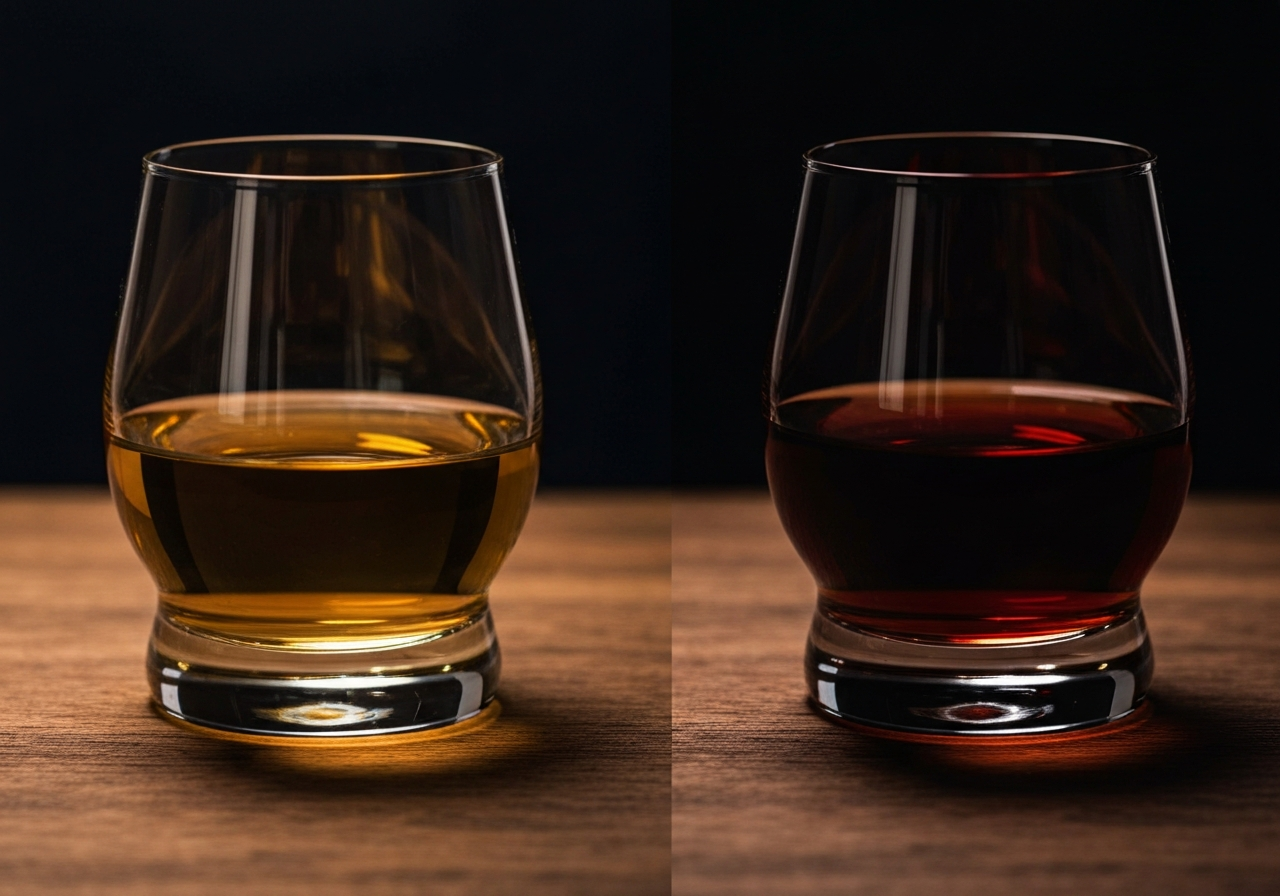
Perhaps the most exciting trend in the modern whiskey flavor profile is the art of "cask finishing." This is a technique where a whiskey spends the majority of its life in a traditional ex-bourbon barrel and is then moved into a different type of cask (like Sherry, Port, Rum, or Wine) for the final 6 to 24 months of aging. This process is like a "costume change" for the whiskey, adding a final layer of complexity that can transform a good dram into a legendary one.
The sherry cask vs bourbon cask debate is a classic one. Sherry casks, particularly those that held Oloroso or Pedro Ximénez (PX) sherry, are the gold standard for creating "Sherry Bombs." These casks impart deep, dark flavors of sun-dried raisins, dates, figs, and dark chocolate. If your whiskey has a reddish tint and tastes like Christmas cake in a glass, you can bet there’s a sherry cask involved. Port pipes (very large casks) are another favorite, contributing a beautiful pinkish-gold hue and flavors of plum, blackberry, and a certain savory "nutty" quality.
But the innovation doesn't stop there. Distillers are increasingly raiding the wine cellars of the world. A Sauternes cask (a French dessert wine) might add honeyed, floral, and apricot notes. A Bordeaux or Burgundy cask can add acidic red berry tartness and a dry, tannic finish. Even Rum casks are having a moment, infusing whiskey with a tropical "funk," molasses sweetness, and hints of grilled pineapple. These casks carry the "ghosts" of the spirits that lived in them before, and those ghosts provide the finishing touches to the whiskey's story.
When you see a bottle labeled "Finished in Port Casks," you aren't just buying whiskey; you're buying a cross-cultural collaboration. It’s the meeting of two different traditions—the grain of the North and the grapes of the South—shaken together in a wooden cradle.
The Angel’s Share and the Role of Climate
No discussion of whiskey maturation is complete without acknowledging the "Angels." In every warehouse in the world, a small percentage of whiskey evaporates through the wood pores every year. This is known as the "Angel’s Share." In the cool, damp climate of Scotland, this loss is about 1% to 2% per year. However, in the sweltering heat of Kentucky or the tropical humidity of Taiwan, that loss can be as high as 10% or more. While it sounds like a waste, this evaporation is vital; it concentrates the remaining liquid and creates room for oxygen to enter the barrel.
The climate acts as the "engine" of maturation. In a warehouse, temperature fluctuations cause the staves to expand and contract. This physically "pumps" the whiskey in and out of the oak. In hot climates like Texas or India, the whiskey is being pumped through the wood at a furious rate. This is why a 4-year-old whiskey from a hot climate can often taste as "mature" as a 12-year-old whiskey from Scotland. It’s not a shortcut; it’s just a different speed of life. However, age is not just a number—a whiskey matured quickly in the heat will have more wood-driven notes, while a whiskey matured slowly in the cold will often have more delicate, ester-driven fruitiness.
Humidity also plays a fascinating role. In a dry warehouse, water molecules (which are smaller) evaporate faster than alcohol molecules. This actually causes the alcohol percentage (ABV) of the whiskey to increase over time. In a damp, coastal warehouse, the alcohol evaporates faster than the water, causing the ABV to decrease. Even the height of the barrel in the warehouse matters. The "top floor" of a Rickhouse in Kentucky is significantly hotter than the ground floor. Two barrels from the same batch, distilled on the same day, can taste like completely different whiskeys after ten years just because one sat higher in the rafters than the other.
Exotic Woods and the Future of Maturation
While oak is the king, the borders of the whiskey world are expanding. Distillers are looking for new ways to surprise our palates, leading to a surge in experimentation with exotic woods. The most famous of these is Mizunara, or Japanese Oak. This wood is incredibly rare and expensive; a single Mizunara tree can take 200 years to reach maturity, and the wood is so porous that it’s notorious for leaking. However, the flavor is unmistakable—it adds unique notes of sandalwood, agarwood incense, and a distinct "oriental" spice that you simply can't get from Western oak.
In Ireland and parts of Europe, we’re seeing a resurgence of Chestnut and Acacia barrels. Chestnut offers a very different tannin structure, often leading to a nuttier, slightly more astringent profile, while Acacia is known for providing bright, floral aromatics that complement lighter spirits. There’s even innovation in the construction of the casks themselves. Some forward-thinking distilleries are creating "hybrid casks" with American oak staves and European oak heads, trying to capture the bright vanilla sweetness and the deep spicy finish all in one vessel.
Of course, innovation isn't without controversy. Some modern producers use "wood staves" (planks of wood dropped into a stainless steel tank) or "wood chips" to speed up the infusion of flavor. While this is legal for some spirits, traditionalists often scoff at it, arguing that you lose the "breathing" and oxidation that only a real barrel can provide. Finally, there is the question of sustainability. The global thirst for whiskey is higher than ever, and high-quality oak is a finite resource. The industry is moving toward more responsible forestry and "cask management" to ensure that we can keep enjoying these "wood whispers" for generations to come. The future of whiskey is rooted in the health of our forests.
Conclusion: How to Read a Label and Choose Your Next Bottle
Now that you’ve decoded the secrets of the cask, how do you use this knowledge at the liquor store? The next time you’re browsing the shelves, stop looking at the age statement for a moment and start looking for keywords. If a label says "Ex-bourbon casks," expect a profile that is light, sweet, and honey-forward—perfect for a sunny afternoon. If it says "Sherry Cask Matured," prepare for something rich, dark, and fruity that pairs perfectly with a fireplace and a good book.
Don’t be afraid of "Non-Age Statement" (NAS) whiskeys. Many enthusiasts dismiss them, but if a distillery is using high-quality "first-fill" casks, a 6-year-old whiskey can often be more flavorful and complex than an 18-year-old whiskey that sat in "tired," fourth-fill wood. Use a simple mental "Wood Map" to categorize what you like: do you prefer the spicy/heavy influence of European oak, or the sweet/creamy profile of American white oak? Knowing your preference will save you a lot of expensive guesswork.
At the end of the day, remember that the barrel is the whiskey’s co-author. The distiller writes the first half of the story—the grain, the water, the fermentation—but the wood finishes it. It provides the punctuation, the adjectives, and the emotional resonance that turns a spirit into an experience. I encourage you to try a "horizontal tasting" soon: find two whiskeys from the same distillery—perhaps one aged in bourbon and one in sherry—and taste them side-by-side. You’ll hear the "wood whispers" clearer than ever before.
Love exploring the world of whiskey? Make sure to log your next discovery in the DramNote app to track how different casks influence your favorite pours!