Whiskey's Watermark: Decoding Source & Mineral Impact
Discover how the water used in distillation profoundly shapes your favorite dram.
The Forgotten Ingredient: Beyond Grain and Wood
When we talk about whiskey, we tend to get swept up in the romance of the charred oak barrel or the specific strain of heirloom barley. It is common to hear brand ambassadors and enthusiasts alike claim that upwards of 70% of a whiskey’s flavor profile comes directly from the wood. While the barrel is undoubtedly a titan of flavor, we often overlook the most fundamental element of the spirit. Depending on the bottling strength, water makes up between 60% and 90% of the liquid currently sitting in your glass. It is the silent partner, the literal lifeblood of the distillery, and the foundation upon which every other flavor is built.
If you look back through the annals of spirits history, you’ll find that the location of every legendary distillery—from the sea-sprayed warehouses of Bowmore on Islay to the rolling hills of Buffalo Trace in Kentucky—was determined by one thing above all else: a reliable whiskey water source. Before the days of modern piping and industrial filtration, you built your distillery where the water was pure, plentiful, and consistent. You couldn't just manufacture the right profile; you had to find it in the earth. This proximity wasn't just about convenience; it was about survival and character.
In the world of whiskey distillation science, water isn't just one thing; it wears three distinct hats during its journey through the distillery. First, there is "process water," used for cooling the massive condensers and cleaning the equipment. Then, there is "ingredient water," which enters the mash tun to help convert starches into sugars. Finally, there is "reduction water," the pristine liquid used to proof the spirit down from its fiery cask strength to a more approachable bottling strength. Each of these roles demands a specific chemical profile.
What makes this truly fascinating is the concept of "chemical memory." Water isn't just H2O; it is a geological record of the land it traveled through. As it seeps through soil, dances over moss, or sits in ancient underground aquifers, it picks up trace elements—minerals, salts, and organic compounds—that create a unique signature. These elements cannot be perfectly replicated by throwing a handful of salts into a tank of distilled water. The foundation of any regional style begins with the hard vs soft water whiskey distinction. Whether a water source is "soft" (low in minerals) or "hard" (rich in calcium and magnesium) sets the stage for everything that follows, from the efficiency of the mash to the texture on your tongue.

Geology in the Glass: Surface vs. Ground Water Sources
To understand the mineral impact on whiskey, we have to look at where the water spends its time before it hits the distillery gates. Water sources generally fall into two categories: surface water and groundwater. Surface water—think of the burns of Scotland, the lochs of the Highlands, or the rivers of Ireland—is a reflection of the atmosphere and the vegetation. In Scotland, many distilleries utilize water that has run through miles of peat moorlands. This gives the water a distinct brownish hue, almost like a weak tea, and introduces organic acids that can influence the final spirit's character. While the "peatiness" of the water isn't the same as the smoke from kilning the malt, it adds an earthy, vegetal base layer that is uniquely Highland.
On the other hand, we have groundwater and aquifers. This water has spent decades, sometimes centuries, filtering through deep layers of rock. This process naturally purifies the water while imbuing it with a heavy mineral load. One of the greatest benefits of groundwater is its thermal consistency. Most aquifers stay at a steady 50-55°F year-round. In the world of distillation, cold water is vital for efficient condensation. If the water used to cool the stills gets too warm, the alcohol vapors won't turn back into liquid effectively, which can stall production during the summer months.
Geology plays a starring role here. Consider the Speyside region of Scotland. Much of the water there is filtered through ancient granite. Granite is an incredibly hard, non-porous rock that doesn't give up many minerals. The result is exceptionally soft water. This lack of mineral "clutter" is exactly why Speyside malts are known for their elegance; the soft water allows the delicate, fruity esters produced during fermentation to shine through without being masked by heavy mineral notes. It’s like a clean canvas waiting for a master painter.
Contrast this with the limestone water bourbon found in the American South. Kentucky and Tennessee sit atop a massive prehistoric limestone shelf. This geological feature is a distiller's dream. As water passes through the limestone, it acts as a natural filter, stripping away bitter iron—the sworn enemy of the distiller—while enriching the water with calcium. This "Bluegrass" water is famous not just for building the strong bones of Triple Crown racehorses, but for creating a sweet, clean base for corn-heavy mashes. A perfect example is the legendary Jack Daniel’s Cave Spring Hollow. Flowing at a constant 56 degrees and producing 800 gallons per minute, this limestone-filtered miracle has provided the exact same water profile since 1866. Without that specific cave, Jack Daniel’s simply wouldn't be Jack Daniel’s.
The Chemistry of the Mash: Mineral-Driven Enzyme Activity
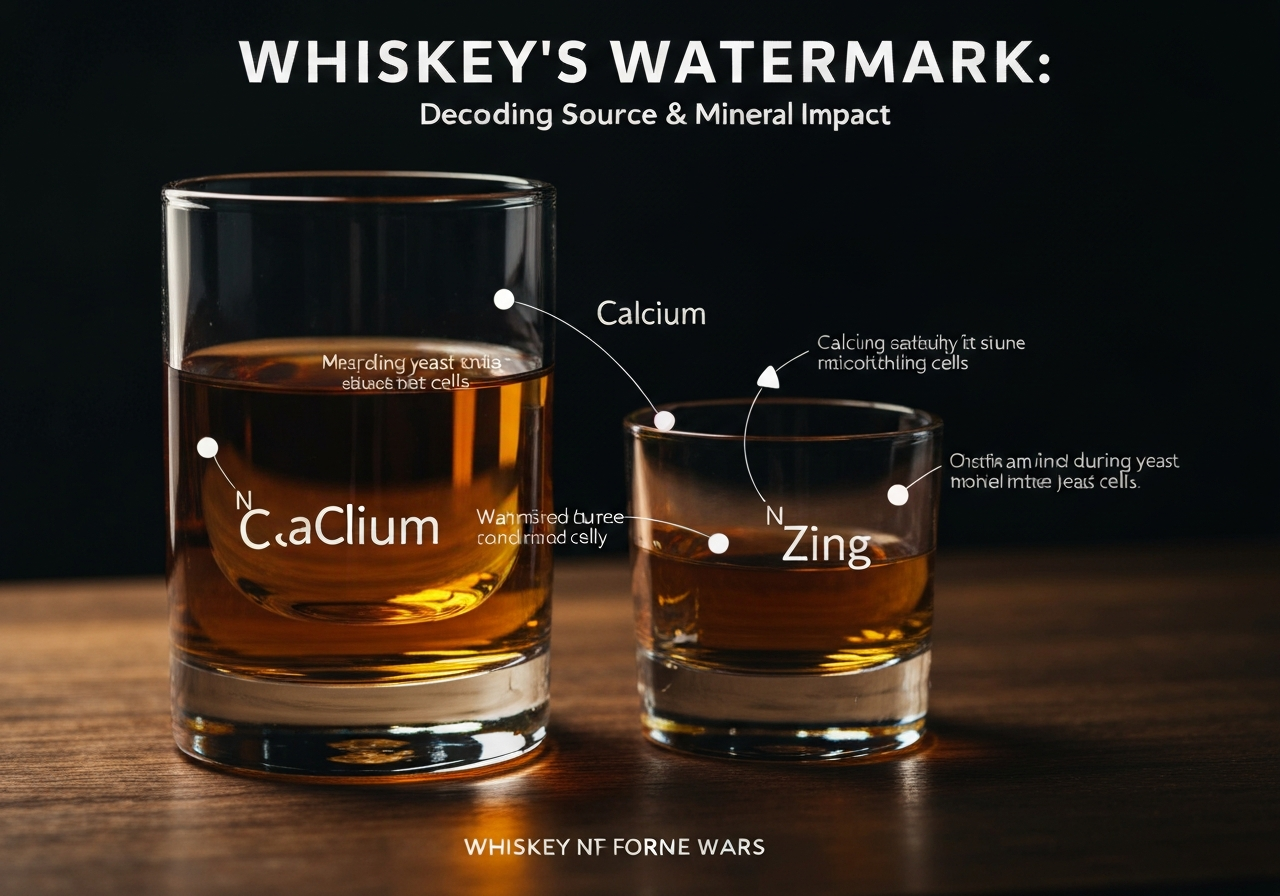
Once the water enters the mash tun, we transition from geology to pure chemistry. This is where the mineral impact on whiskey becomes a functional necessity rather than just a flavor contributor. The mashing process is essentially an enzymatic reaction where we convince the grain to give up its starches and turn them into fermentable sugars. The star of this show is calcium. Calcium is the most critical mineral during mashing because it acts as a stabilizer for alpha-amylase, the enzyme responsible for breaking down complex starches. Without sufficient calcium, these enzymes can degrade under the high heat of the mash, leading to poor sugar extraction and a lower alcohol yield. Distillers using very soft water often have to monitor this closely to ensure their enzymes are performing at their peak.
Magnesium plays a supporting role to calcium, aiding in yeast metabolism later in the process. However, it is a delicate balancing act. While a little magnesium is helpful, an excess can impart a metallic or even bitter "after-note" to the new-make spirit that no amount of barrel aging can truly hide. It is this fine-tuning of mineral ratios that separates a good distiller from a master of the craft.
Another crucial factor is the pH balance of the mash. For optimal starch-to-sugar conversion, distillers aim for a mash pH between 5.2 and 5.5. The alkalinity of the whiskey water source acts as a buffer. If the water is too alkaline (common in high-carbonate "hard" water), it can resist the natural acidification that happens during mashing, potentially stalling the conversion process. This is why some distillers will "sour" their mash—adding a portion of the spent mash from a previous distillation—to help bring that pH back into the sweet spot. It’s a beautiful dance between the natural alkalinity of the earth and the biological needs of the grain.
We must also give a nod to the "hidden" heroes and villains of whiskey distillation science. Zinc, even in tiny amounts as low as 0.1 to 0.2 parts per million (ppm), is a mandatory co-factor for the enzymes that allow yeast to convert sugar into ethanol. It’s a tiny spark that keeps the engine running. On the flip side, we have iron. Iron is the ultimate distiller's enemy. Even 1 ppm of iron can react with the polyphenols in the grain and the wood to turn a whiskey a sickly, ink-like black. More importantly, it creates an astringent, metallic flavor profile that is utterly ruinous. This is why that limestone filtration we mentioned earlier is so vital; limestone naturally precipitates iron out of the water, ensuring the spirit remains golden and sweet.
Fermentation Dynamics: How Minerals Shape Yeast Esters
After mashing, we move to the fermentation tanks—or "washbacks" as they are called in Scotland. This is where the magic (and the flavor) really happens. The debate between hard vs soft water whiskey takes an interesting turn here. You might assume that "purer" soft water is always better, but that isn't necessarily the case for flavor complexity. Harder water, rich in minerals, tends to promote a very efficient, "clean" fermentation. The yeast has everything it needs to thrive, so it goes about its work quickly and efficiently.
Interestingly, softer water can actually "stress" the yeast slightly. In the world of whiskey, a little bit of stress isn't always a bad thing. When yeast is challenged, it often produces a wider array of secondary metabolites known as esters. These are the chemical compounds responsible for those wonderful notes of green apple, tropical fruit, and flowers. So, while hard water might give you a higher yield and a cleaner spirit, soft water can often result in a heavier, more complex ester profile. It is a trade-off that every distillery must decide upon when choosing their water source.
"The water isn't just an ingredient; it is the environment in which the yeast lives, breathes, and creates the soul of the spirit."
Then there is the "flocculation" factor. Calcium ions are essential for helping yeast cells clump together (flocculate) at the end of the fermentation process. If the yeast clumps well, it settles to the bottom of the tank, leaving a clearer "wash" to be pumped into the stills. If the water is too soft and lacks calcium, the yeast may stay in suspension, leading to a cloudy wash that can produce "off" flavors when boiled in the copper pot stills. It’s these tiny physical interactions that dictate the clarity and purity of the final distillate.
We also have to consider the specific salts present: sulfates vs. carbonates. High sulfate content—common in the waters of Burton-on-Trent in England but also found in some whiskey regions—can enhance a crisp, dry finish in the final spirit. Carbonates, conversely, tend to lead to a rounder, softer mouthfeel. Furthermore, the presence of chlorides can actually increase the perception of "sweetness" and body. This is why some whiskeys feel oily and rich on the palate even before they've seen a day in a barrel. It isn't just the grain; it's the mineral-driven texture born in the fermentation tank.
Copper and Condensation: The Distillation Interaction
As the fermented wash enters the stills, the water continues to play a role, albeit a more physical one. One of the most overlooked aspects of whiskey distillation science is how water minerals interact with the copper of the still itself. Over time, hard water can cause "scaling"—a buildup of mineral deposits on the interior surfaces of the still. While this might sound like a maintenance nightmare, it actually changes the way the spirit vapor interacts with the copper. Copper is essential for stripping away unwanted sulfur compounds (think of that "rotten egg" smell). If the copper is coated in mineral scale, the surface area available for this chemical reaction decreases, potentially altering the character of the spirit.
Furthermore, the mineral density of the cooling water used in the worm tubs or column condensers affects thermal conductivity. The goal is to turn alcohol vapor back into liquid as precisely as possible. The speed and temperature at which this happens influence "reflux"—the process where heavier vapors condense and fall back down to be re-distilled. This reflux is what creates a lighter, more refined spirit. If the cooling water isn't up to the task due to its mineral composition or temperature, the resulting whiskey might be heavier and funkier than intended.
A fascinating anomaly in this world is Glenmorangie. Most Scottish malt distilleries swear by soft water, but Glenmorangie famously uses exceptionally hard, mineral-rich water from the Tarlogie Springs. They even bought the land around the springs to ensure no one would ever mess with their whiskey water source. Despite having the tallest stills in Scotland—which usually produce a very light, delicate spirit—the minerals in their water contribute to a unique citrusy and floral complexity that has become their trademark. It’s a perfect example of how breaking the "rules" of mineral content can create a world-class icon.
There is also an element of distillery legend here. Many old-school stillmen believed that the water and the still were "married." They believed that if you changed the water source, you would "kill the still's soul." This is because the internal patina—the layer of oxidation and mineral deposits inside the copper—is calibrated to that specific water input over decades. When a distillery moves or tries to replicate its process elsewhere, the water is the hardest thing to get right. You can buy the same grain and the same yeast, but you can't easily replicate the geological history of a specific spring.
The Final Touch: Reduction Water and Bottling Strength
The most direct impact a consumer feels from water is at the very end of the process. When a whiskey is "cut" from its cask strength (often 60% ABV or higher) down to its bottling strength (usually 40-46% ABV), the quality of the water is arguably more impactful than at any other stage. At this point, there is no more boiling, no more fermentation, and no more wood to hide behind. The water you add is the water people will taste. This is the ultimate expression of mineral impact on whiskey.
One common issue during this stage is the "Louching Effect" or chill haze. Whiskey contains fatty acid esters that are soluble in alcohol but not in water. When you add reduction water, you lower the alcohol concentration, which can cause these esters to precipitate and turn the liquid cloudy. If the reduction water has a high mineral content, this cloudiness can be even more pronounced. This is why many non-chill-filtered whiskeys will turn slightly "milky" when you add an ice cube or a splash of water at home. It’s a sign of a natural, chemically complex spirit.
Distillers must also be careful of "osmotic shock." If you add the reduction water too quickly, it can "bruise" the whiskey. This is an exothermic reaction—it actually generates a small amount of heat—which can momentarily dull the more delicate top notes of the spirit. Master blenders often add water in stages over several weeks to let the spirit and the water "marry" slowly, ensuring the flavors remain integrated and harmonious. It is a slow, methodical process that requires a lot of patience.
In the modern industry, there is a divide between traditionalists and modernists regarding reduction water. Most large-scale producers use Reverse Osmosis (RO) water. This process strips every single mineral and impurity out of the water, creating a "blank slate." This ensures that a bottle of whiskey tastes the same whether it was bottled in June or January, and whether it’s being sold in London or Tokyo. However, some purists argue that RO water "strips the soul" from the dram. They prefer using filtered spring water that retains some of its original mineral character, believing it provides a more authentic sense of "terroir."
And let’s not forget the "drop of water" myth. Why does adding a teaspoon of water to your glass at home actually work? It isn't just about diluting the alcohol burn. Science shows that adding water releases guaiacol molecules. Guaiacol is hydrophobic—it hates water. When you add that splash, the guaiacol molecules are pushed to the surface of the liquid, bringing smoky, spicy, and peaty aromas right to your nose. It’s like opening a window in a crowded room; suddenly, everything becomes clearer and more vibrant.
Case Studies: Iconic Water Sources Around the Globe
To truly appreciate the whiskey water source, we should take a trip around the world to see how geology has shaped the spirits we love. We’ve already mentioned the limestone water bourbon of Kentucky, but it’s worth reiterating how fundamental that limestone shelf is. Without it, American whiskey would likely have remained a localized, rough-around-the-edges product. The calcium-rich water allowed for the development of the sweet, vanilla-forward, and deep mahogany profile that defines modern Bourbon. It is a spirit built on a foundation of prehistoric sea shells.
Traveling across the Atlantic to the rugged island of Islay, we find Laphroaig. They use water from the Kilbride Stream. This water is so heavily influenced by the surrounding peat bogs that it is dark, mossy, and earthy before it even reaches the distillery. When you taste the medicinal, sea-salt, and boggy notes of Laphroaig, you aren't just tasting smoked malt; you are tasting the very liquid that has spent years soaking in the Islay soil. It is perhaps the most prominent example of water providing a direct link to the land.
In Japan, the approach to water is one of almost religious reverence. When Shinjiro Torii sought the perfect spot for the Yamazaki distillery, he chose a location at the confluence of three rivers: the Katsura, the Uji, and the Kizu. This area is famous for its "bamboo-filtered" soft water, which is credited for the legendary silky, velvety texture of Japanese whisky. In Japan, the purity and "softness" of the water are seen as a reflection of the spirit’s elegance. It is whiskey distillation science practiced with the precision of a tea ceremony.
We are also seeing new profiles emerge from continental Europe. Distilleries in the Alps or the Nordic regions often use glacier meltwater. This water is incredibly "young" and pure, often exhibiting a crispness and a crystalline quality that differs significantly from the earthy, mineral-heavy profiles of traditional Scottish Highland malts. These whiskeys often have a "bright" quality, with high-toned fruit notes that feel incredibly refreshing.
To put this in perspective, a scientific study of 20 different Scottish distilleries showed that water hardness varied by over 400% across the group. This proves that there is no such thing as a singular "Scottish water" profile. Instead, Scotland is a patchwork of geological signatures. Every time you try a new dram, you are essentially taking a geological survey of a specific glen or hillside. The mineral impact on whiskey is the true map of the whiskey world.
The Modern Debate: Standardized Science vs. Natural Terroir
As we look to the future, the industry finds itself at a crossroads. On one side, we have the drive for consistency. With whiskey becoming a global phenomenon, the pressure to ensure that every bottle of a flagship brand tastes identical is immense. This has led to the widespread use of Reverse Osmosis and the "re-mineralization" of water. Some modern distilleries strip their water down to zero and then add back a precise "recipe" of minerals—the exact amount of calcium, magnesium, and zinc required for a perfect fermentation. It is whiskey distillation science at its most clinical.
On the other side, we have the "Terroir" movement. Craft distillers and traditionalists are pushing back against this homogenization. They argue that the slight batch variations caused by seasonal changes in the whiskey water source are part of the charm. They use unfiltered "raw" water, believing that the local "fingerprint" of the minerals is what gives a whiskey its sense of place. For these producers, whiskey should be a living product of its environment, not a laboratory-controlled chemical compound.
Climate change is also adding a new layer to the conversation. In recent years, exceptionally dry and warm summers in Scotland have forced some distilleries to pause production. When the burns run low or the water temperature rises, it becomes impossible to cool the stills efficiently. This is forcing the industry to rethink its relationship with water, moving toward "water neutrality" and more sustainable cooling practices. The water source is no longer just an ingredient to be used; it is a resource that must be protected if the distillery is to survive for another century.
Ultimately, while grain provides the sugar and wood provides the spice, water is the life-force that conducts the entire symphony of whiskey production. It is the medium through which all other flavors travel. The next time you pour yourself a dram, take a moment to look at the liquid in the glass. It may be clear, but it carries the weight of the earth, the memory of the rocks, and the chemistry of the springs. It is the watermark of the distillery, and it is the most important ingredient you’ve probably been ignoring.
Practical Tip: If you want to experience the mineral impact on whiskey for yourself, try a side-by-side tasting. Take a high-proof whiskey and split it into two glasses. Dilute one with distilled water and the other with a mineral-rich spring water (like Evian or Highland Spring). You will be amazed at how much the mouthfeel and the finish change based on nothing more than the minerals in the water.