Whiskey's Accents: Decoding Regional Styles Simply
Discover the unique 'dialects' of whisky from around the globe.
The Linguistic Map of Spirits: Understanding Whiskey Dialects
When you walk into a dimly lit whisky bar, the sheer volume of bottles on the back shelf can feel overwhelming. It is like standing in the middle of a crowded international airport; you hear a hundred different voices, but you aren’t quite sure what they are saying. As a whisky blogger for DramNote, I often tell newcomers that learning about whisky regional styles is very much like learning a language. Every bottle has an accent, a specific way of speaking to your palate that reveals exactly where it came from.
Before we dive into the flavors, let’s address the most common question in any types of whiskey guide: the spelling. Why do some bottles say "Whisky" while others insist on "Whiskey"? It is the first clue to the spirit's origin. Generally, the "e" is used in Ireland and the United States. Meanwhile, Scotland, Japan, and Canada stick to the leaner "Whisky." A simple trick to remember is that countries with an "e" in their name (United States, Ireland) use the "e," while those without (Scotland, Japan, Canada) do not. It is the first "dialect" shift you will notice on the label.
But the accent goes much deeper than the label. Just as a person’s voice is shaped by the culture and geography of their home, a spirit’s profile is dictated by its local "terroir." This includes the local water source, the specific grains grown nearby, and the climate where the barrels rest. In our whiskey tasting for beginners sessions, we break production down into four pillars: grain selection, fermentation/distillation, maturation environment, and local tradition. While experts often cite the "80/20 rule"—the idea that the oak barrel provides up to 80% of the final flavor—it is that remaining 20%, the regional production accent, that provides the vital soul and personality of the spirit.
If you are just starting out, don't let the technical jargon or the "expert" barrier intimidate you. You don't need to know the chemical composition of peat to know you like the smell of a campfire. Trust your own palate. Your tongue is the best translator you have for these global dialects. Whether it is a soft lilt from the Scottish Lowlands or a bold Southern drawl from Kentucky, every sip tells a story of its homeland.
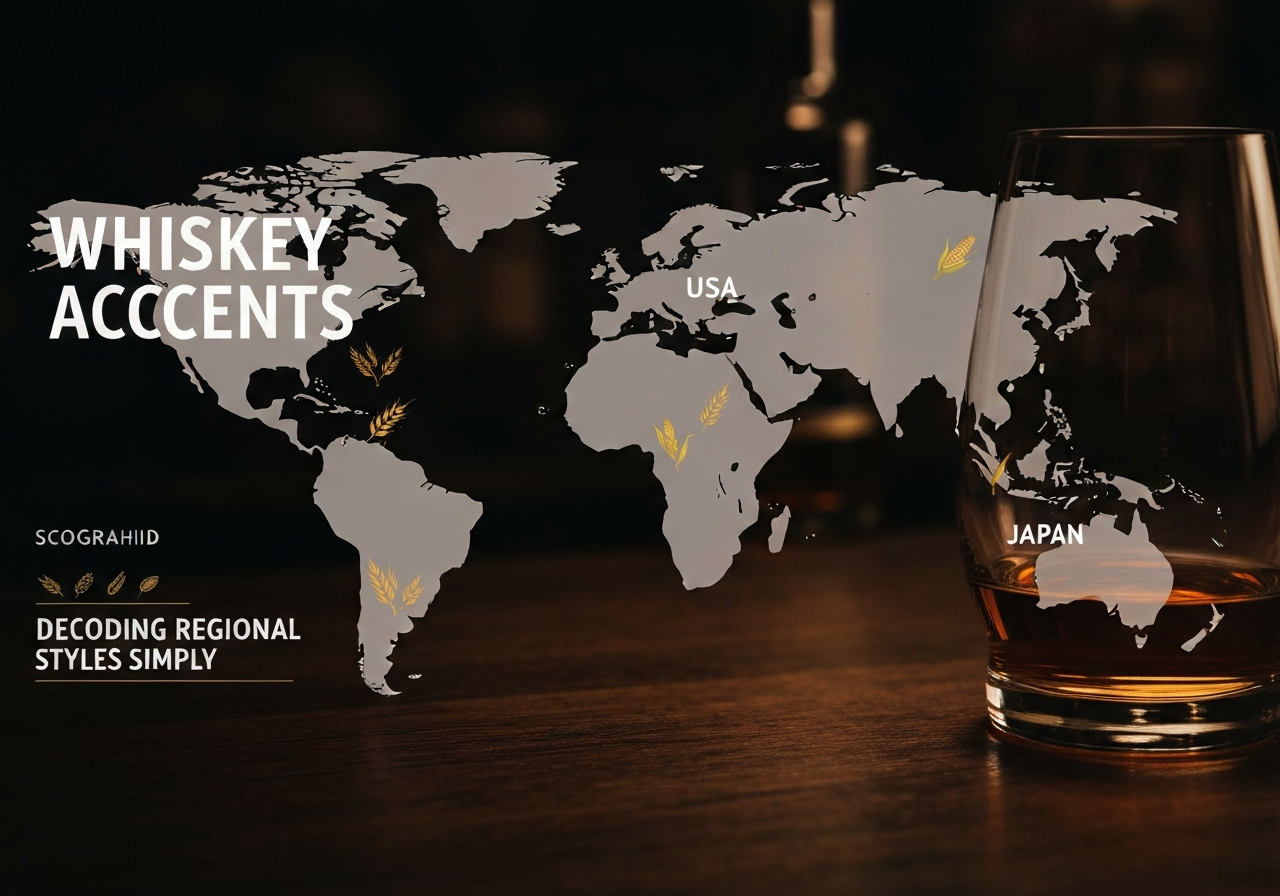
Scotland's Speyside and Lowlands: The Gentle Lilt
If we are continuing our linguistic metaphor, the whiskies of Speyside and the Lowlands are the "Received Pronunciation" of the whisky world—elegant, clear, and easy to understand. For many, the journey of scotch vs bourbon for beginners begins right here in the northeast of Scotland.
Speyside is often referred to as the "Golden Triangle." Despite being a relatively small geographic area, it is home to over 50% of Scotland's distilleries. If you have heard of Glenfiddich, The Glenlivet, or The Macallan, you are already familiar with the Speyside accent. These whiskies are famous for their "honeyed" profile. They are approachable, often bursting with notes of orchard fruits like green apple and pear, balanced by a delicate sweetness that reminds one of heather honey. The secret behind this clarity is often the stills themselves. Speyside distilleries frequently use tall, slender copper stills that allow only the lightest vapors to reach the top, resulting in a refined, elegant spirit.
Further south, we find the Lowlands. Often referred to as the "Lowland Ladies," these whiskies offer an even gentler lilt. Traditionally, many Lowland distilleries utilize triple distillation, whereas most Scotch is double-distilled. This third trip through the copper still strips away even more of the heavier oils and cereal notes, leaving a spirit that is light, floral, and grassy. If you are a wine drinker who typically gravitates toward a crisp Chardonnay or a zesty Pinot Grigio, the Lowlands will likely be your favorite dialect.
Take Auchentoshan as a case study. Their commitment to triple distillation creates a spirit so light and citrus-forward that it is often jokingly called the "whisky for breakfast." It lacks the aggressive "bite" that people often fear when they first try Scotch. Instead, you get a palate of lemon zest, cut grass, and vanilla. When exploring islay vs speyside, these regions represent the "polite" side of the conversation—perfect for those who want to ease into the world of malt without being overwhelmed by smoke or spice.
Scotland's Islay and Highlands: The Rugged Brogue
Now, we move from the manicured gardens of the south to the wild, windswept coasts. If Speyside is a gentle poem, Islay (pronounced Eye-la) is a seafaring epic shouted over a thunderstorm. This is where we encounter the "rugged brogue" of the whisky world, defined by one key ingredient: Peat.
Peat is essentially compressed organic matter—moss, heather, and grasses—that has decayed over thousands of years. In the absence of coal, historical Scottish distillers burned dried peat to heat the kilns that dried their malted barley. This process infuses the grain with phenols, which translate into flavors of campfire smoke, charred wood, and sometimes even "medicinal" notes like iodine or Band-Aids. For a beginner, the Islay "punch" can be shocking. There is a famous anecdote about Laphroaig, one of Islay’s most iconic distilleries; its medicinal profile was so distinct that during American Prohibition, it was legally sold in pharmacies as "medicine" because authorities couldn't believe anyone would drink it for pleasure!
The Highlands, the largest whisky region in Scotland, acts as the bridge between these styles. Because the region is so vast, its accent varies wildly. You might find the rich, sherried sweetness of The Dalmore in one glen, and the coastal, salty tang of Old Pulteney in another. This "maritime influence" is a crucial part of the Highland and Island dialect. Distilleries sitting right on the edge of the Atlantic or the North Sea allow their barrels to breathe in the salty sea air for decades. Over time, that brine penetrates the oak, giving the whisky a distinct savory edge that balances the natural sweetness of the malt.
When beginners ask about the "Peat Monster" concept, they are usually referring to these heavy-hitting Islay and Highland drams. It is an acquired taste, certainly, but beneath that initial wallop of smoke, there is often a surprising creaminess and a deep, dark fruit character. It is the difference between a sunny day in the park and a cold night by a roaring fire—both are beautiful, but they speak to very different moods.
Ireland: The Smooth Silver Tongue
If you've ever listened to a master Irish storyteller, you know the words flow with a certain rhythm and ease. Irish vs Scottish whiskey is one of the most debated topics in any bar, but the primary distinction lies in that famous Irish "smoothness." While Scotland is known for its diversity of smoke and fruit, Ireland is the master of the "silver tongue"—whiskies that are incredibly easy to drink, velvety on the tongue, and consistently welcoming.
The secret to this accessibility is the signature triple distillation. While some Scotch (like our friends in the Lowlands) does this, it is the standard for the vast majority of Irish whiskey. This process creates a higher alcohol purity and removes the heavier, grainier elements of the spirit. But there is another secret weapon in the Irish arsenal: "Single Pot Still" whiskey. This is a style unique to Ireland that uses a combination of both malted and unmalted (green) barley. The result is a texture that is wonderfully creamy and "biscuity," often carrying a signature pot-still spice that feels like a gentle prickle of white pepper on the mid-palate.
Historically, the Irish whiskey industry has been through a dramatic saga. In the 19th century, Ireland was the world's leading producer, but a perfect storm of the Irish War of Independence, a trade war with Britain, and American Prohibition nearly wiped the industry out. By the 1970s, the country had gone from over 100 distilleries to just two. Thankfully, we are currently living through a modern revival. Irish whiskey is the fastest-growing spirit category globally, with new distilleries popping up from Dingle to Dublin.
When you are exploring this region, look for the classic flavor profiles of vanilla, shortbread, and tropical fruits. A standard Jameson offers that reliable, light sweetness, while something like Redbreast showcases the heavy, oily, dried-fruit richness of the pot-still style. It is a friendly, articulate dialect that rarely raises its voice, making it a staple in any whiskey tasting for beginners.
The American Bourbon: The Bold Southern Drawl
Crossing the Atlantic brings us to a completely different linguistic landscape. If Scotch is about tradition and subtle nuance, American Bourbon is about volume, sweetness, and bold, unapologetic character. It is the "Southern drawl" of the spirit world—warm, expansive, and incredibly hospitable.
To be called Bourbon, a whiskey must follow a strict set of rules, the most important being the "Corn Connection." By law, the mash bill (the recipe of grains) must be at least 51% corn. Corn is a high-sugar grain, and it provides the inherent caramel and vanilla sweetness that beginners love. While Scotch relies heavily on the malted barley for flavor, Bourbon gets its punch from the grain and, more importantly, the "Virgin Oak Rule." Bourbon must be aged in brand-new, charred oak containers. Because the wood has never been used before, it is packed with wood sugars, vanillin, and tannins that have been "caramelized" by the charring process. This is why Bourbon often tastes like toasted marshmallows, coconut, and brown sugar.
The climate of Kentucky also plays a massive role in this regional accent. Unlike the cool, damp, and steady temperatures of Scotland, Kentucky experiences intense seasonal swings. In the heat of a Kentucky summer, the whiskey expands and is pushed deep into the pores of the oak barrel. In the winter, it contracts and pulls back out, bringing all those wood flavors with it. This accelerates the aging process significantly. This extreme climate leads to a high "Angel’s Share"—the amount of whiskey that evaporates from the barrel each year. To give you an idea of how much Bourbon means to the region, consider this: Kentucky currently has approximately 11 million barrels of bourbon aging in warehouses, which is more than double the human population of the state (about 4.5 million)!
When identifying the Bourbon accent, look for big, bold flavors. You aren't looking for subtle hints of grass or sea salt here; you are looking for baking spices like cinnamon and nutmeg, heavy oak, and a rich, syrupy mouthfeel. It is a hearty, friendly style that makes its presence known the moment it hits your glass.
Tennessee Whiskey and Rye: The Spicy Variations
While Bourbon is the king of American spirits, it has a few close relatives that speak with their own unique inflections. The most famous is Tennessee Whiskey. While it is very similar to Bourbon in its grain makeup, it undergoes one extra step that changes its entire "tone": The Lincoln County Process.
Before the spirit goes into the barrel for aging, it is filtered through ten feet of sugar maple charcoal. Think of this like a linguistic filter that smooths out the rough edges of a dialect. The charcoal "mellows" the spirit, stripping away some of the harshness and adding a subtle hint of soot or a clean, maple-like sweetness. This is what gives Jack Daniel's its signature profile. It is still bold and sweet, but it has a "polished" quality that distinguishes it from its Kentucky neighbors.
Then, we have Rye whiskey—the spicy, edgy cousin of the family. To be classified as Rye, the grain bill must be at least 51% rye grain rather than corn. Rye was the original "accent" of the American Northeast, particularly Pennsylvania and Maryland, before the industry shifted west toward the corn-rich fields of Kentucky. Rye doesn't have the round, sugary sweetness of Bourbon; instead, it offers a "bite" that tastes like black pepper, fresh dill, and clove. It is lean, muscular, and incredibly expressive.
Because of this bold, spicy accent, Rye is the darling of the cocktail world. If you are making an Old Fashioned or a Manhattan, the spicy character of Rye stands up much better against bitters and sweet vermouth than the softer notes of Bourbon. It is the "noir" version of American whiskey—moody, complex, and full of character.
Japan: The Precise and Articulate Whisper
The story of Japanese whisky is one of the most fascinating chapters in our types of whiskey guide. It is a story of "transplanted" language. In 1918, a young man named Masataka Taketsuru traveled from Japan to Scotland to learn the secrets of Scotch production. He returned home with a Scottish wife and a notebook full of technical drawings, eventually helping to found the powerhouses we know today as Suntory and Nikka.
However, the Japanese didn't just copy Scotch; they refined it. The Japanese whisky regional styles are characterized by a philosophy known as "Kaizen"—the relentless pursuit of continuous improvement. While a Scottish distillery might have one or two types of stills, a single Japanese distillery often houses a vast array of still shapes and sizes, using various yeast strains and fermentation times. This allows them to produce an incredible range of "dialects" all under one roof. Because Japanese distilleries rarely trade casks with one another (unlike the Scots), they must be self-sufficient in creating the diverse components needed for their blends.
One of the most unique markers of the Japanese accent is the use of Mizunara oak. This rare and expensive Japanese oak is notoriously difficult to work with—the trees grow crooked and the wood is porous—but the flavor it imparts is unlike anything else in the world. It gives the whisky a hauntingly beautiful aroma of sandalwood, temple incense, and coconut. It turns a drink into a meditative experience.
The general japanese whisky characteristics are clarity, balance, and a silky texture. These whiskies don't shout; they whisper with perfect articulation. This precision makes them exceptionally well-suited for food pairing. In Japan, the "Highball"—whisky topped with high-quality sparkling water and lots of ice—is the preferred way to enjoy the spirit alongside a meal. It stretches the flavors out, allowing the subtle nuances to shine without overwhelming the palate.
Canada and the New World: Emerging Slang
Finally, we look to the "New World" of whisky, where the rules are being rewritten and new "slang" is being invented every day. Canada has long been a powerhouse of production, but it operates with a unique quirk known as the "9.09% Rule." This regulation allows distillers to add up to 9.09% of non-whisky spirits—such as Sherry, Port, or even wine—to their blends to enhance the flavor. While some purists scoff, it allows for a creative, fruit-forward profile that is distinctively Canadian.
But the real excitement is happening in "New World" regions like Taiwan and India. In these tropical climates, the heat is a massive factor. While a Scotch might take 12 years to reach maturity in the cold Highlands, a whisky from Kavalan in Taiwan or Amrut in India might reach that same level of "wood interaction" in just 3 or 4 years. The heat accelerates the aging process, creating whiskies that are incredibly dark, oily, and concentrated. Indian whiskies often use six-row barley grown at the foothills of the Himalayas, which has a higher protein content, resulting in a thicker, more "chewy" mouthfeel compared to traditional European malts.
Australia is also making waves, particularly in Tasmania. Australian distillers have taken a page from their world-class wine industry, often aging their spirits in local Shiraz or Apera (Australian Sherry) barrels. This results in vibrant, berry-forward whiskies that taste like "summer in a glass." This is the "Wild West" of the distilling world. Without the strict legal shackles of the Scotch Whisky Association or the Bourbon laws, these distillers are free to experiment with local grains, unique woods, and varied climates. It is a exciting, fast-paced conversation where the vocabulary is changing every year.
Decoding the Label: Your Translator Guide
Now that you understand the accents, how do you read the "passport" that is the bottle label? This is where many beginners get tripped up, but a few simple rules can act as your translator. First, look at the ABV (Alcohol by Volume). A standard bottle is usually 40-43%, but if you see "Cask Strength," it means the whisky hasn't been diluted with water before bottling. These are "loud" whiskies, often reaching 55-60% ABV. They can hide or amplify regional accents depending on how you drink them.
Next, consider the age statement. Remember that age is not a direct measurement of quality, but rather a measurement of "time spent in the wood." As we learned with the scotch vs bourbon for beginners comparison, a 4-year-old Bourbon might be "older" in character than a 10-year-old Scotch because of the intense Kentucky heat. Don't be fooled into thinking older is always better; sometimes the youthful "accent" of the grain is exactly what you want.
Two other terms to watch for are "Non-Chill Filtered" and "Natural Color." Chill-filtration is a process that removes fats and oils so the whisky doesn't get cloudy when you add ice. However, those oils carry a lot of the regional flavor and texture. If a label says "Natural Color," you know the rich amber hue comes entirely from the barrel, not from added caramel coloring (E150a). These bottles usually offer a more "authentic" regional profile.
Finally, the tools of the trade matter. Using a tulip-shaped glass, like a Glencairn, acts like a megaphone for the whisky’s accent. It concentrates the aromas at the top, making it much easier for a beginner to identify the notes of peat, fruit, or vanilla. And never be afraid to add a few drops of water! Water "unlocks" the spirit, breaking the surface tension and releasing aromatic esters. It is much like asking someone to speak a little slower so you can better understand their dialect.
Conclusion: Finding Your Native Tongue
The world of whisky is a vast, global conversation. From the salty sea-breeze of a coastal Highland malt to the spicy, rye-driven kick of a Manhattan-ready American spirit, there is a style for every palate and every occasion. As you continue your journey, remember that your palate is a muscle. The more "conversations" you have with different regions, the better you will become at identifying these beautiful accents.
If you want to put this into practice, I highly recommend a home experiment. Try a "Horizontal Tasting"—pick three different Scotches from three different regions (perhaps a Speyside, an Islay, and a Highland). Notice how their "voices" differ. Or, try a "Vertical Tasting"—try three different ages of the same Bourbon to see how the "accent" deepens and matures over time. You will quickly find that there is no "best" regional style; there is only the style that speaks most clearly to you.
The next time you find yourself at a whisky bar, don't just ask for "a whiskey." Ask for a flight based on these regions. Tell the bartender you want to hear the difference between a Speyside lilt and an Islay growl. This global diversity is what makes our hobby so endlessly fascinating. Every bottle is a liquid postcard from a distant land, just waiting for someone to listen to what it has to say. So, raise a glass to the world of whisky—a world that never stops talking, and one where there is always something new to learn. Slàinte!