Whiskey & Cheese: A Pairing Masterclass
Discover the unexpected harmony between fine cheeses and your favorite whiskies.
The Evolution of a Gourmet Marriage: Beyond Wine and Cheese
For decades, the culinary world has held wine and cheese as the undisputed power couple of the dinner party. It is a classic pairing, etched into our collective gastronomic DNA. But as the craft spirits movement has exploded over the last twenty years, a new contender has emerged to challenge the throne. At DramNote, we’ve spent a lot of time documenting the nuances of the "water of life," and if there is one thing we have learned, it’s that a whiskey and cheese pairing can offer a level of depth that wine simply cannot reach. This isn't just a modern trend; it is a return to shared agricultural roots.
Historically, whiskey and cheese have lived parallel lives. Both are products of the farm, born from a necessity to preserve seasonal abundance. Cheese began as a way to store the caloric richness of summer milk through the winter, while whiskey (or its ancestor, uisce beatha) was a way to transform surplus grain into a shelf-stable, high-value spirit. Both rely entirely on the transformative power of fermentation and, most importantly, the patience of time-based maturation. Whether it is a wheel of cheddar aging in a cool cave or a cask of malt sitting in a dunnage warehouse on the coast of Islay, the goal is the same: the development of complex, tertiary flavors through controlled oxidation and environmental interaction.
This cultural shift toward spirit-based pairings is what many are calling the "New Frontier" of sensory exploration. While wine offers acidity and fruit, whiskey brings a robust intensity, high ABV, and wood-derived tannins that can stand up to even the most pungent, fatty cheeses. When you bring these two together, you encounter what connoisseurs call the "Third Flavor." This is the magical moment where the chemical interaction between the spirit and the dairy creates a profile that exists in neither element alone. You might find that a certain scotch and a specific blue cheese suddenly taste like dark chocolate-covered cherries—a note that wasn't present in the glass or on the plate beforehand.
"Whiskey doesn't just sit alongside cheese; it interrogates it, pulling out hidden sweetness and smoothing over the jagged edges of salt and funk."
In Scotland, this isn't news. For centuries, the "Whisky and Cheese" trail has wound through the Highlands and Islands, where local creameries and distilleries have collaborated to sustain local communities. In the Orkney Islands, for instance, it is a long-standing tradition to pair the local Highland Park with a wedge of sharp, island-made cheddar. They understand that the heather-honey smoke of the malt is the perfect foil for the creamy, slightly saline notes of the cheese. This masterclass is designed to help you recreate that centuries-old wisdom in your own home, turning a simple snack into a profound whisky tasting guide experience.
The Molecular Symbiosis: Why High Proof Meets High Fat
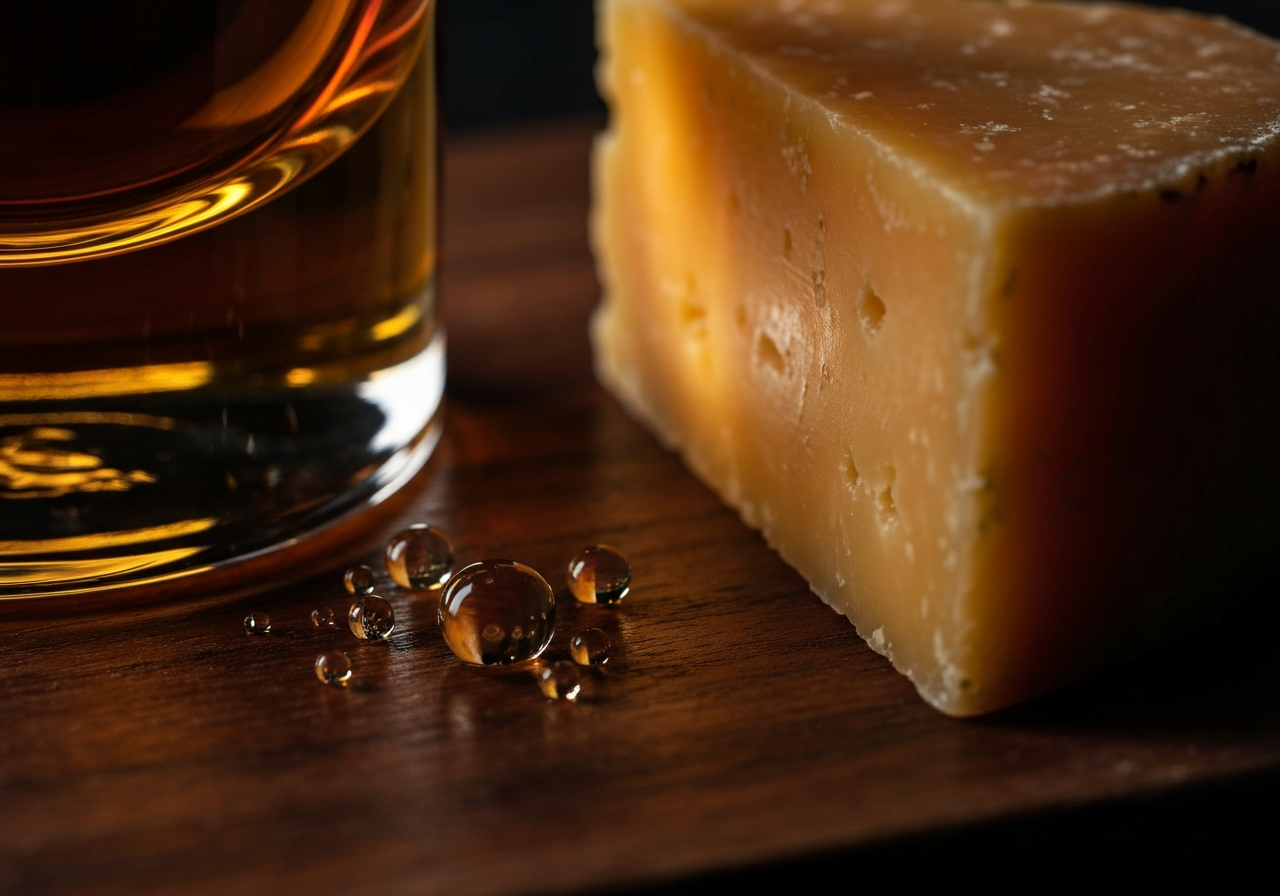
To truly master the whiskey masterclass, one must look under the hood at the science of why this pairing works so effectively. It isn't just luck; it’s molecular biology. The primary reason whiskey often outperforms wine in these pairings is its high alcohol by volume (ABV). Ethanol acts as a solvent. When you eat a piece of rich, triple-cream brie or a dense, crystalline aged gouda, your palate becomes coated in heavy lipid chains—essentially, a layer of fat. While this fat carries flavor, it also dulls your taste buds. The high proof of whiskey cuts through this fat like a hot knife, stripping the palate clean and preparing it for the next bite. This "Science of Palate Cleansing" ensures that the tenth bite of cheese tastes as vibrant as the first.
Beyond the alcohol, we must consider the role of tannins and proteins. Tannins are polyphenolic compounds extracted from the oak barrels during the whiskey's years of slumber. In wine, tannins can often feel "grippy" or astringent, sometimes clashing with the proteins in cheese. However, in whiskey, these wood-derived tannins have a different structure. When they meet the proteins in a hard cheese, they bind together, effectively smoothing out the "bite" or "burn" of the spirit. This is why a high-proof bourbon and cheese pairing can often feel surprisingly smooth; the cheese is literally mellowing the spirit in real-time on your tongue.
Then, we have the aromatic echoes provided by congeners. Congeners are the chemical byproducts of fermentation and distillation—esters, aldehydes, and phenols—that give whiskey its unique character. Interestingly, the ripening process of cheese involves similar microbial pathways. A long-aged cheese develops esters that mimic the fruity, floral notes of a Speyside malt. A funky, washed-rind cheese contains sulfur compounds that can find a sympathetic partner in a "meaty" or "dirty" style of whiskey, like a Mortlach. This sensory analysis of whiskey reveals a shared vocabulary of flavor that creates a seamless bridge between the glass and the board.
The salt vs. sweet dynamic is perhaps the most pleasing part of the molecular puzzle. Many premium whiskies, particularly those matured in Sherry or Port casks, carry a significant amount of residual sugars and dried fruit notes. When these meet the high saline content of a Roquefort or an aged Manchego, you get the classic "salted caramel" effect. The salt in the cheese enhances the sweetness of the whiskey, while the sugar in the whiskey tames the aggression of the salt.
Finally, there is the "Ethanol Burn Mitigation." Many people find high-proof spirits intimidating because the heat of the alcohol can overwhelm delicate flavors. However, the fat coating from a piece of cheese acts as a protective barrier for the vanilloid receptors on your tongue. This protection allows more nuanced notes—like the scent of pressed orchids, toasted oats, or light lemon zest—to emerge from the whiskey without being drowned out by the heat of the ethanol. It turns a "burn" into a "glow," making the entire experience much more accessible.
Light & Floral: Pairing Fresh Cheeses with Lowland and Irish Whiskies
When starting your journey, it is best to begin with the lighter side of the spectrum. Fresh cheeses, such as Chèvre (goat cheese), Ricotta, and Burrata, are defined by their high moisture content and delicate, lactic acid-driven flavor profiles. They are bright, tangy, and often have a "clean" finish. To pair these successfully, you need a spirit that provides a "lifting" effect rather than one that will steamroll the dairy's subtlety. This is where triple-distilled Irish whiskies and Lowland Scotch come into play.
Lowland whiskies, often referred to as the "Lowland Ladies," are known for their floral, grassy, and citrusy notes. A classic example is Auchentoshan. Because these spirits are often light-bodied, they don't overwhelm the delicate creaminess of a fresh Ricotta. Instead, they act like a squeeze of lemon over the cheese, highlighting its natural sweetness. Similarly, the honeyed, smooth profile of a traditional Irish whiskey creates a beautiful harmony with the tangy "zing" of a fresh goat cheese. In this whisky tasting guide, we recommend looking for bottles that mention "citrus," "green apple," or "fresh-cut grass" on the label.
One of our favorite specific recommendations is pairing a log of ash-ripened goat cheese with a citrus-forward whiskey like Glenkinchie 12 Year Old. The herbaceous notes in the cheese resonate with the grassy character of the malt, while the whiskey’s finish cleanses the palate of the cheese’s slightly chalky texture. If you want to take it a step further, consider the role of carbonation. A Whiskey Highball—whiskey topped with high-quality sparkling water and a twist of lemon—is a secret weapon for fresh cheese pairings. The bubbles provide a physical scrub to the palate, maintaining a light mouthfeel that perfectly matches the "airy" quality of a Burrata.
For a more decadent experience, look toward a honeyed Highland malt paired with Buffalo Mozzarella. While Mozzarella is often thought of as a pizza topping, a high-quality, fresh Mozzarella di Bufala has a rich, gamey sweetness. A whiskey like Aberfeldy 12, known for its distinct honey-pot notes, brings out a creamy, almost dessert-like quality in the cheese. It is a subtle, elegant pairing that proves you don't need smoke or high proof to make a lasting impression on the palate.
The Maillard Connection: Aged Bourbons and Sharp Cheddars
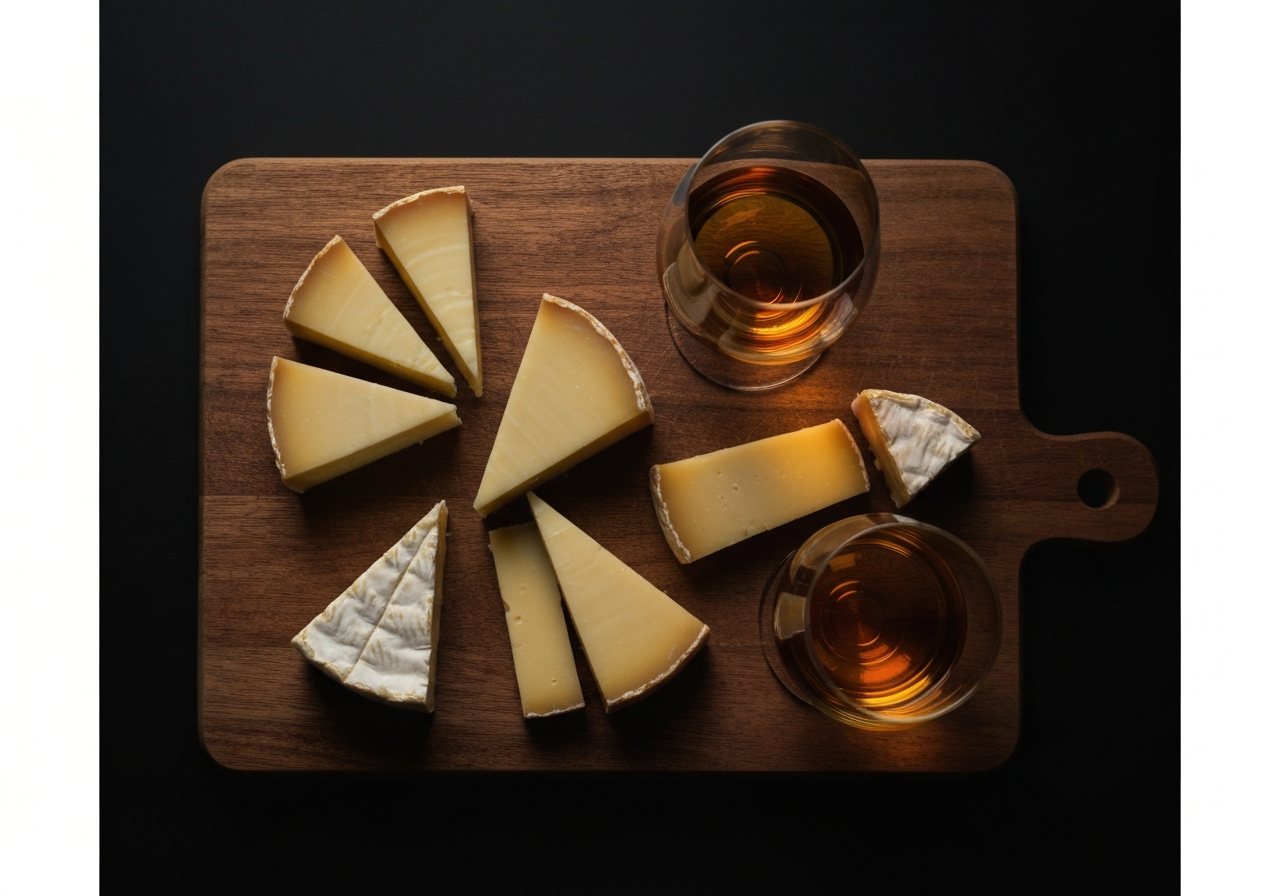
As we move into heavier flavors, we enter the realm of the Maillard Reaction. This is the chemical reaction between amino acids and reducing sugars that gives browned food its distinctive flavor—think of the crust on a steak or the golden hue of toasted bread. In the world of bourbon and cheese, the Maillard connection is the glue that holds everything together. Bourbons are aged in new, charred American oak barrels. The heat of the charring process caramelizes the sugars in the wood, creating notes of toffee, vanilla, and toasted nuts. These are the exact same flavor markers found in a high-quality, extra-aged Cheddar or a 24-month Gouda.
When you taste a sharp English clothbound cheddar, you’ll often notice little "crunchy bits." These are tyrosine crystals, a byproduct of protein breakdown during the aging process. These crystals offer a savory, nutty explosion that mirrors the toasted notes of a high-rye bourbon. The spicy kick of the rye in the whiskey (think Basil Hayden or Bulleit) acts as a counterpoint to the intense, earthy, and sometimes "farmy" notes of the cheddar. The spice cuts through the density of the cheese, while the cheese provides a rich, fatty base that lets the bourbon’s spice sing without being harsh.
The "Vanilla Bridge" is another crucial element here. Vanillin is one of the primary flavor compounds extracted from oak. In aged cow’s milk cheeses, a natural sweetness develops over time that mimics this vanilla profile. When you pair a 100-proof Kentucky Straight Bourbon with a crystalline aged Gouda, the vanillin in the spirit bridges the gap to the sweetness in the milk. It creates a profile that tastes remarkably like butterscotch or salted toffee. It’s a pairing that feels big, bold, and unashamedly indulgent.
Texture matching is equally important in this category. A crumbly, aged cheese needs a whiskey with an oily, full-bodied mouthfeel. If the whiskey is too thin, it will get lost in the "crunch" of the tyrosine crystals. A cask-strength bourbon, with its higher oil content and concentrated flavors, provides a textural weight that matches the density of the cheese. The heat of a 100+ proof spirit also helps to physically melt the cheese on your tongue, releasing aromas of roasted corn and caramel that would otherwise remain trapped in the cold fat. This is the heart of a whiskey masterclass: understanding that flavor is only half the battle—texture is where the real magic happens.
Sherry Casks and Alpine Wonders: The Nutty Spectrum
If you prefer your whiskey with a bit of European flair, the world of Sherry-matured malts offers a playground for cheese lovers. Whiskies aged in Oloroso or Pedro Ximénez casks are famous for their notes of raisins, dried plums, figs, and dark chocolate. These "Sherry bombs" (like The Macallan, GlenDronach, or Aberlour) have a rich, oxidative character that is the perfect match for Alpine-style cheeses. We’re talking about the greats: Comté, Gruyère, Emmental, and Beaufort.
Alpine cheeses are made using specific bacteria cultures that produce a characteristic "nutty" and "savory" profile. Because these cheeses are often "cooked" during the cheesemaking process, they develop a dense, elastic texture and a deep umami flavor. The "rancio" effect—a culinary term describing the rich, nutty, and slightly pungent notes found in oxidized products—exists in both Sherry-matured whiskies and long-aged Alpine rinds. When these two meet, they don't just pair; they amplify one another’s savory depth.
Think of a glass of GlenDronach 18 Year Old. It is essentially liquid fruitcake—dense, dark, and sweet. When sipped alongside a 24-month-aged Comté, the cheese’s nutty, browned-butter notes provide a savory floor for the whiskey’s fruit notes to dance on. The salt in the Comté makes the dried fruit notes of the whiskey pop, while the whiskey’s sweetness rounds off the slight "funk" of the cheese’s rind. This is scotch cheese pairings at its most sophisticated.
The synergy in umami here is profound. Both products are rich in glutamates, the compounds responsible for that "moreish" savory sensation. By combining them, you are maximizing the umami potential of your palate. It is a heavy, satisfying combination that is best enjoyed slowly, perhaps at the end of a long meal. The key is to ensure the cheese is firm enough; a soft cheese will be overwhelmed by the intensity of the Sherry cask, but a firm, nutty Alpine cheese has the structural integrity to stand its ground.
Peat, Smoke, and Funk: The Islay vs. Blue Cheese Paradigm
Now we come to the most polarizing and powerful section of our whisky tasting guide: the pairing of heavily peated malts and blue cheese. This is not for the faint of heart, but for those who love big flavors, it is the holy grail. Whiskies from Islay, like Laphroaig, Ardbeg, and Lagavulin, are famous for their medicinal, smoky, and often seaweed-heavy profiles. These are aggressive spirits that require an equally aggressive partner. Enter the "funk" of the blue mold: Roquefort, Gorgonzola, and Stilton.
The magic here lies in the "Smoke-Salt-Cream Triangle." The medicinal smoke of the peat is physically and chemically rounded off by the creamy, salty "funk" of the Penicillium roqueforti mold in the cheese. It is a bizarre but brilliant transformation. When you take a sip of Laphroaig after a bite of Roquefort, the "iodine" and "bandage" notes of the whiskey often transform into something sweet and savory, like smoked bacon or honey-glazed ham. This "Bacon Effect" is one of the most famous sensory illusions in the world of spirits.
Historically, the tradition was "Stilton and Port"—a pairing of salty cheese and sweet, fortified wine. While classic, many modern enthusiasts find it a bit one-dimensional. Islay single malt is the modern, more complex successor to Port. It offers the sweetness (especially if it’s a peated malt with some Sherry cask influence, like Bowmore), but it adds a layer of atmospheric smoke that elevates the saltiness of the blue cheese into something truly otherworldly. It feels like a campfire on a stormy beach.
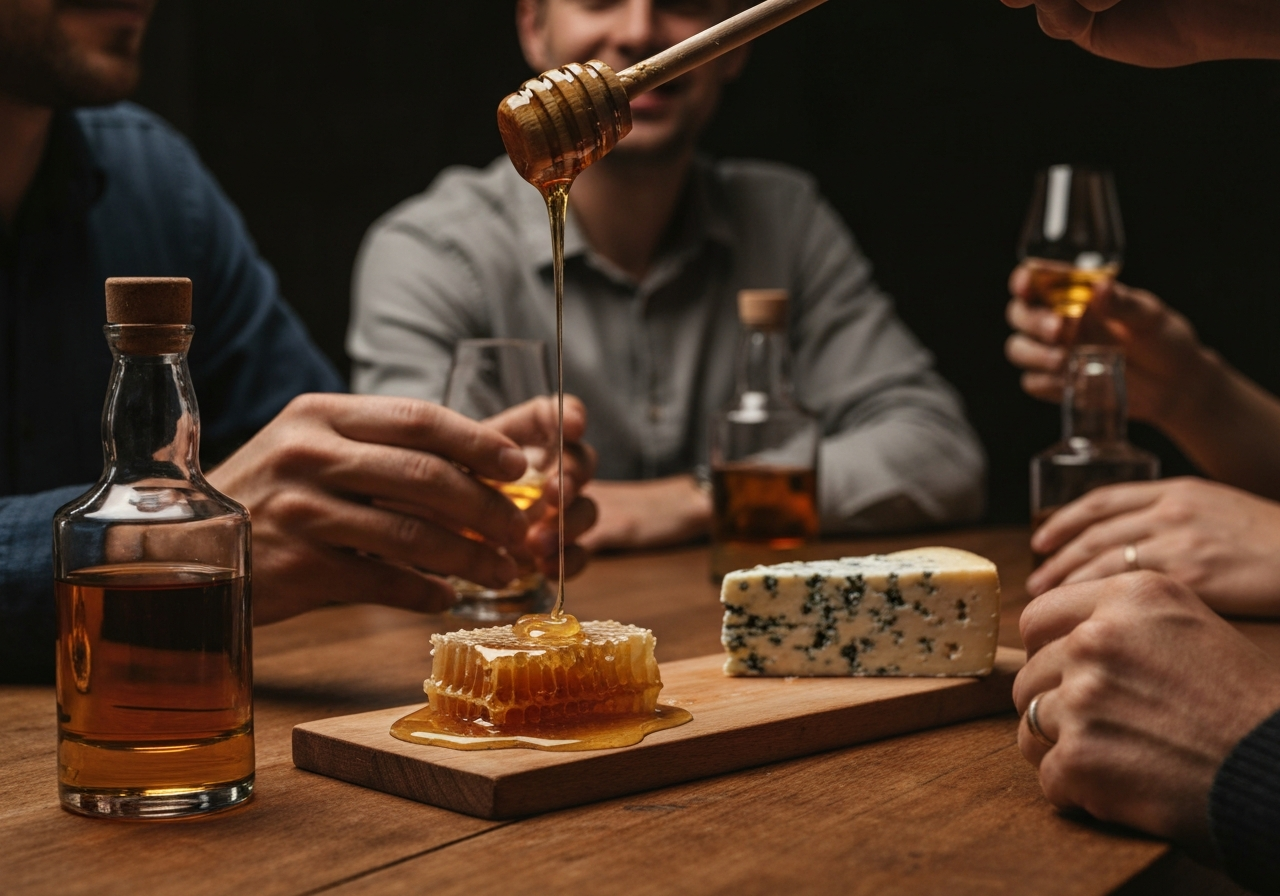
Managing intensity is the secret to success here. If you have an exceptionally high-phenol whiskey (like an Octomore), you need a cheese that can match its "parts per million" of smoke with its own "parts per million" of blue-veined intensity. If one dominates the other, the experience becomes lopsided. A tip for the best cheese for peated scotch: if the whiskey is particularly "dry" and ashy, go for a creamier blue like Gorgonzola Dolce to provide some much-needed moisture. If the whiskey has some fruitiness, go for a crumbly, punchy Stilton to provide a sharp contrast.
"Pairing Islay malt with Roquefort is like watching two titans fight; eventually, they realize they’re better off as allies, and the result is spectacular."
The Ritual of the Tasting: Setup and Execution
To truly elevate your whiskey and cheese pairing from a casual snack to a curated masterclass, the "how" is just as important as the "what." We recommend the "Two-Sip Method." This is the gold standard for sensory analysis. First, take a small sip of the whiskey to prime your palate and understand its baseline character. Then, take a small bite of the cheese, letting it melt on your tongue and coating your mouth. Finally, take a second sip of the whiskey while the cheese is still present. This is when the transformation happens—observe how the finish of the whiskey changes and what new notes emerge from the dairy.
Temperature is a non-negotiable factor. Never serve cheese cold. When cheese is straight from the fridge, the fats are solid and the aromatic compounds are "locked in." You’ll miss 50% of the flavor. Take your cheese out of the refrigerator at least one hour before tasting so it can reach room temperature. This allows the fats to soften and the "nose" of the cheese to develop. Similarly, while some prefer whiskey with ice, for a pairing masterclass, we recommend serving it neat or with just a few drops of room-temperature water. Ice will dull your taste buds and prevent you from experiencing the chemical bridge between the two elements.
Glassware selection plays a vital role. While a tumbler is fine for a casual drink, a Glencairn glass or a tulip-shaped snifter is superior for pairings. The tapered mouth of the glass concentrates the volatile aromatics, allowing you to smell the whiskey and the cheese simultaneously as you lean in for a sip. This olfactory connection is where the brain begins to "stitch" the two flavors together before they even hit your tongue.
Lastly, don't forget your palate cleansers. Between different pairings—especially when moving from a light Lowland to a heavy Islay—you need to reset your senses. Room temperature water is essential, but neutral crackers (like water crackers) or slices of tart green apple are also excellent. The apple, in particular, has enough acidity to strip away lingering cheese fats without introducing a distracting flavor of its own. When arranging your board, go from lightest to boldest, ensuring your palate isn't blown out by a blue cheese in the first five minutes.
Building the Bridge: Using Accoutrements to Enhance the Bond
Sometimes, a whiskey and a cheese are almost a perfect match, but they just need a little help to cross the finish line. This is the "Bridge Philosophy." By using a third ingredient—an accoutrement—you can connect disparate flavors. For example, if you find a Rye whiskey is a bit too spicy for a particular goat cheese, a drizzle of honeycomb can provide the waxy sweetness needed to soften the blow and create a harmonious trio. The honey acts as the "bridge" that links the grain of the rye to the tang of the cheese.
Nuts are another incredible texture tool. Marcona almonds, walnuts, or pecans can echo the wood-driven tannins in older, well-aged whiskies. The oils in the nuts interact with both the spirit and the dairy, adding a crunch that contrasts beautifully with softer cheeses. For Sherry-cask whiskies, dried fruits like apricots, figs, or even dates are essential. They highlight the stone-fruit notes in the malt and provide a chewy texture that slows down the tasting process, encouraging you to linger on the flavors longer.
However, be wary of "Flavor Killers." While we love a good charcuterie board, overly acidic pickles, olives in harsh brine, or spicy peppers can be disastrous for a whiskey masterclass. The high acidity of vinegar crashes into the delicate chemistry of the whiskey, often making the spirit taste bitter or metallic. Similarly, extreme heat from chili can numb the tongue, making it impossible to detect the subtle esters you’ve worked so hard to find. Stick to "earthy," "sweet," and "salty" bridges rather than "sour" or "spicy."
Dark chocolate is a secret weapon, particularly when dealing with peated scotches or aged bourbons. A small shard of 70% cacao chocolate can act as a bridge between a smoky Ardbeg and a salty Stilton, adding a layer of bitterness and richness that rounds out the "Bacon Effect." It turns the pairing into a full-sensory experience that covers every part of the palate: sweet, salty, bitter, sour, and umami.
Curating Your Masterclass Board: Three Winning Flights
Ready to put theory into practice? Here are three curated flights to get you started. Each is designed to show a different side of the whiskey and cheese pairing world.
- Flight 1: The Beginner (Accessibility & Balance)
- The Dram: Jameson Irish Whiskey (Smooth, floral, approachable).
- The Cheese: A creamy Brie or Camembert.
- The Bridge: A slice of green apple.
- Why it works: The "triple-distilled" smoothness of the Jameson won't frighten the palate, and the light floral notes lift the heavy cream of the Brie.
- Flight 2: The Connoisseur (Complexity & Texture)
- The Dram: Wild Turkey Rare Breed (Cask strength bourbon, high proof, big spice).
- The Cheese: 5-Year Aged Gouda or a Clothbound Cheddar.
- The Bridge: Toasted walnuts.
- Why it works: The high ABV cuts through the dense crystals of the Gouda, while the vanilla notes in the bourbon find their mirror image in the aged milk.
- Flight 3: The Bold Explorer (Intensity & Contrast)
- The Dram: Laphroaig 10 Year Old (Heavy peat, sea salt, smoke).
- The Cheese: Roquefort or a high-quality Stilton.
- The Bridge: Dark chocolate shards (70% cocoa).
- Why it works: The ultimate "funk vs. smoke" battle that results in a savory, chocolatey, smoky masterpiece.
When it comes to quantities, we recommend approximately 0.5 to 1 oz of whiskey and about 1 oz of cheese per person per pairing. This is a marathon, not a sprint. The goal is to explore the interaction, not to overindulge. As you go, make sure to use your DramNote app to document your findings. Did the pairing work? What notes did you find? Was there a "Third Flavor"?
Ultimately, the most important rule of any whisky tasting guide is to trust your own palate. While these "rules" are based on chemistry and tradition, everyone’s sensory receptors are different. You might find a pairing we’ve never thought of that works perfectly for you. Don't be afraid to experiment, swap out a Scotch for a Japanese whisky, or try a local artisan cheese from your own neighborhood. The "water of life" and the "soul of the milk" are ancient partners—your job is simply to reintroduce them. Cheers!